CAS 16879-53-1
:4-Pyrimidinecarboxylic acid, 2-phenyl-
Description:
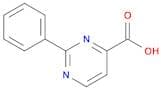
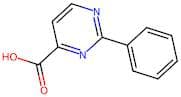
4-Pyrimidinecarboxylic acid, 2-phenyl- is an organic compound characterized by its pyrimidine ring structure, which is a six-membered heterocyclic aromatic ring containing two nitrogen atoms at positions 1 and 3. This compound features a carboxylic acid functional group (-COOH) at the 4-position of the pyrimidine ring and a phenyl group (a benzene ring) at the 2-position. The presence of these functional groups contributes to its potential acidity and reactivity. It is typically a white to off-white crystalline solid and is soluble in polar solvents, which is common for compounds containing carboxylic acid groups. The compound may exhibit biological activity, making it of interest in pharmaceutical research. Its molecular structure allows for various interactions, including hydrogen bonding, which can influence its solubility and reactivity in different environments. As with many organic compounds, safety data should be consulted to understand its handling and potential hazards.
Formula:C11H8N2O2
Sort by
Purity (%)
0
100
|
0
|
50
|
90
|
95
|
100
Found 4 products.
4-Pyrimidinecarboxylic acid, 2-phenyl-
CAS:Formula:C11H8N2O2Purity:97%Color and Shape:SolidMolecular weight:200.19342-Phenylpyrimidine-4-carboxylic acid
CAS:2-Phenylpyrimidine-4-carboxylic acidPurity:97%Molecular weight:200.19g/mol2-Phenylpyrimidine-4-carboxylic acid
CAS:Formula:C11H8N2O2Purity:97%Color and Shape:SolidMolecular weight:200.1972-phenylpyrimidine-4-carboxylic acid
CAS:2-Phenylpyrimidine-4-carboxylic acid is a luminescent copper complex that has been synthesized as a ligand in coordination complexes. It is soluble in dilute solutions and can be used to prepare the complexes of other metals. 2-Phenylpyrimidine-4-carboxylic acid has been shown to have an affinity for lanthanide metal ions and can be used as a sensitizer for lanthanides. The magnetic properties of this compound were determined using x-ray diffraction on single crystals. It was found that the compound is paramagnetic and has a weak antiferromagnetic interaction with dysprosium, which was confirmed by elemental analysis and diffraction measurements.Formula:C11H8N2O2Purity:Min. 95%Molecular weight:200.19 g/mol