CAS 16931-35-4
:1H-Benzimidazole,4-chloro-(9CI)
Description:
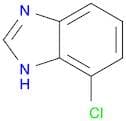
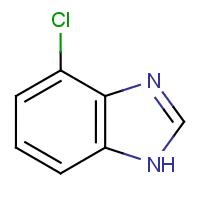
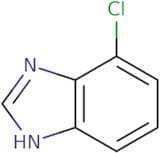
1H-Benzimidazole, 4-chloro- (CAS 16931-35-4) is a heterocyclic organic compound characterized by a fused benzene and imidazole ring structure, with a chlorine substituent at the 4-position of the benzimidazole moiety. This compound typically exhibits properties such as being a white to off-white solid, with moderate solubility in polar solvents like water and alcohols, while being less soluble in non-polar solvents. It is known for its potential biological activity, including antimicrobial and antifungal properties, making it of interest in pharmaceutical research. The presence of the chlorine atom can influence its reactivity and interaction with biological targets. Additionally, 1H-benzimidazoles are often studied for their role in various chemical reactions and as intermediates in the synthesis of more complex molecules. Safety data indicates that, like many chemical substances, it should be handled with care, following appropriate safety protocols to minimize exposure and environmental impact.
Formula:C7H5ClN2
InChI:InChI=1/C7H5ClN2/c8-5-2-1-3-6-7(5)10-4-9-6/h1-4H,(H,9,10)
SMILES:c1cc(c2c(c1)nc[nH]2)Cl
Synonyms:- 4-chloro-1H-benzimidazole
Sort by
Purity (%)
0
100
|
0
|
50
|
90
|
95
|
100
Found 4 products.
1H-Benzimidazole,4-chloro-(9CI)
CAS:Formula:C7H5ClN2Purity:97%Color and Shape:SolidMolecular weight:152.58104-Chloro-1H-benzimidazole
CAS:4-Chloro-1H-benzimidazolePurity:97%Color and Shape:SolidMolecular weight:152.58g/mol4-Chloro-1H-benzimidazole
CAS:4-Chloro-1H-benzimidazole is a synthetic nucleophile that reacts with thioethers to form an ion pair. It can be used as a precursor for the synthesis of captopril, an antihypertensive drug. 4-Chloro-1H-benzimidazole is also known to react with carboxylic acids to form ion pairs and then dehydrate to form electrostatically bound products. The reaction mechanism starts with the nucleophilic attack of a proton on the carbonyl carbon atom in the carboxylic acid, forming an intermediate carbocation which reacts with a chloride ion. This intermediate then collapses and forms two products: one positively charged and one negatively charged. The positively charged product is a chloroformate salt while the negatively charged product is an alcohol.Formula:C7H5ClN2Purity:Min. 95%Molecular weight:152.58 g/mol