CAS 16932-49-3
:2,6-Dimethoxybenzonitrile
Description:
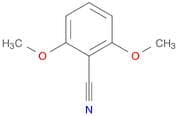
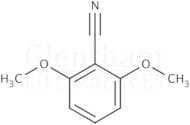
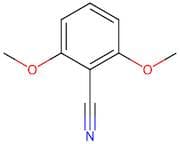
2,6-Dimethoxybenzonitrile, with the CAS number 16932-49-3, is an organic compound characterized by its aromatic structure featuring a benzene ring substituted with two methoxy groups and a nitrile functional group. The methoxy groups are located at the 2 and 6 positions of the benzene ring, which influences the compound's reactivity and solubility. This compound is typically a colorless to pale yellow solid at room temperature and is known for its moderate polarity due to the presence of the nitrile group. It is soluble in organic solvents such as ethanol and acetone but has limited solubility in water. 2,6-Dimethoxybenzonitrile is often utilized in organic synthesis and may serve as an intermediate in the production of pharmaceuticals, agrochemicals, and other fine chemicals. Its chemical properties, including its reactivity and stability, make it a valuable compound in various chemical applications. Safety precautions should be observed when handling this substance, as with many organic compounds, due to potential toxicity and environmental impact.
Formula:C9H9NO2
InChI:InChI=1/C9H9NO2/c1-11-8-4-3-5-9(12-2)7(8)6-10/h3-5H,1-2H3
InChI key:InChIKey=XHAHKSSLDJIEDH-UHFFFAOYSA-N
SMILES:C(#N)C1=C(OC)C=CC=C1OC
Synonyms:- 2-Cyano-3-methoxyanisole
- Benzonitrile, 2,6-dimethoxy-
- Brn 2720059
- NSC 27017
- 2-10-00-00260 (Beilstein Handbook Reference)
- 2,6-Dimethoxybenzonitrile
- AKOS 227-44
- 2,6-dimethoxy-benzonitril
Sort by
Purity (%)
0
100
|
0
|
50
|
90
|
95
|
100
Found 5 products.
2,6-Dimethoxybenzonitrile
CAS:Formula:C9H9NO2Purity:98%Color and Shape:SolidMolecular weight:163.17332,6-Dimethoxybenzonitrile
CAS:2,6-DimethoxybenzonitrilePurity:98%Color and Shape:Beige PowderMolecular weight:163.17g/mol2,6-Dimethoxybenzonitrile
CAS:2,6-Dimethoxybenzonitrile is an organic compound with the formula C8H9NO2. It is a white solid that is soluble in water and polar organic solvents. 2,6-Dimethoxybenzonitrile has three stereoisomers: Z, E and E. The Z form is usually obtained as a mixture of two diastereomers. The other two forms are obtained by reacting with methylamine or acetonitrile respectively. The photodecomposition of 2,6-dimethoxybenzonitrile starts with the generation of nitric oxide (NO) and then formation of quinones such as 9-acetylphenanthrene, which can react with triazolium to generate pyridinium. The reaction mechanism for this process involves bond cleavage followed by methylation reactions at the benzenes and cyanides.Formula:C9H9NO2Purity:Min. 95%Molecular weight:163.17 g/mol