CAS 1701-69-5
:4-Propionylpyridine
Description:
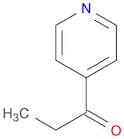
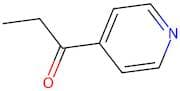
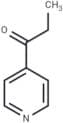
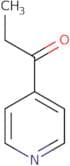
4-Propionylpyridine, with the CAS number 1701-69-5, is an organic compound belonging to the class of pyridine derivatives. It features a pyridine ring substituted with a propionyl group at the 4-position. This compound is typically a colorless to pale yellow liquid with a characteristic odor. It is soluble in organic solvents such as ethanol and ether but has limited solubility in water. The presence of the carbonyl group in the propionyl moiety contributes to its reactivity, making it a potential candidate for various chemical reactions, including condensation and acylation processes. 4-Propionylpyridine is often utilized in organic synthesis and may serve as an intermediate in the production of pharmaceuticals, agrochemicals, and other fine chemicals. Additionally, it may exhibit biological activity, although specific pharmacological properties would require further investigation. As with many organic compounds, proper handling and safety precautions are essential due to potential toxicity and environmental impact.
Formula:C8H9NO
InChI:InChI=1S/C8H9NO/c1-2-8(10)7-3-5-9-6-4-7/h3-6H,2H2,1H3
InChI key:InChIKey=AFHFHXVRHACYSR-UHFFFAOYSA-N
SMILES:C(CC)(=O)C=1C=CN=CC1
Synonyms:- 1-(4-Pyridinyl)-1-propanone
- 1-(4-Pyridyl)-1-propanone
- 1-(Pyridin-4-Yl)Propan-1-One
- 1-Propanone, 1-(4-pyridinyl)-
- 1-Propanone, 1-(4-pyridyl)-
- 4-Pyridyl ethyl ketone
- Ethyl 4-pyridyl ketone
- NSC 31619
- 4-Propionylpyridine
Sort by
Purity (%)
0
100
|
0
|
50
|
90
|
95
|
100
Found 5 products.
1-(4-Pyridinyl)-1-propanone
CAS:1-(4-Pyridinyl)-1-propanone exhibits anticonvulsant activity in mice and is widely used in biochemical experiments and drug synthesis research.Formula:C8H9NOPurity:98.12%Color and Shape:SolidMolecular weight:135.161-(Pyridin-4-yl)propan-1-one
CAS:1-(Pyridin-4-yl)propan-1-one is a catalytic, asymmetric, deuterated solvent that is used in the synthesis of various pyridine alkaloids. Its chemical properties are similar to those of other carbonyl compounds, but it can be differentiated by its catalytic properties. This compound has been shown to be effective at low temperatures and is soluble in a variety of solvents. It also has the ability to bind to metal ions such as chloride or potassium. 1-(Pyridin-4-yl)propan-1-one has been shown to promote growth at temperatures below 37°C and can be used in porcine cells.Formula:C8H9NOPurity:Min. 95%Molecular weight:135.17 g/mol