CAS 1702-18-7
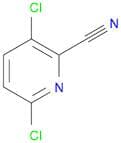
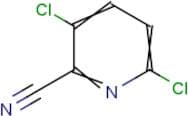
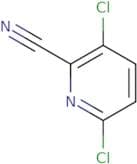
:3,6-dichloropyridine-2-carbonitrile
Description:
3,6-Dichloropyridine-2-carbonitrile is a heterocyclic organic compound characterized by its pyridine ring, which contains two chlorine substituents at the 3 and 6 positions and a cyano group (-C≡N) at the 2 position. This compound is typically a solid at room temperature and is known for its pale yellow to light brown appearance. It is soluble in organic solvents such as acetone and dichloromethane but has limited solubility in water. The presence of both chlorine atoms and the cyano group contributes to its reactivity, making it useful in various chemical syntheses, particularly in the pharmaceutical and agrochemical industries. The compound may exhibit biological activity, which can be explored for potential applications in drug development. Safety precautions should be taken when handling this substance, as it may pose health risks, including irritation to the skin and eyes, and potential toxicity if ingested or inhaled. Proper storage in a cool, dry place away from incompatible substances is recommended to maintain its stability.
Formula:C6H2Cl2N2
Synonyms:- 2-Pyridinecarbonitrile,3,6-dichloro-
Sort by
Purity (%)
0
100
|
0
|
50
|
90
|
95
|
100
Found 4 products.
3,6-Dichloropicolinonitrile
CAS:Formula:C6H2Cl2N2Purity:95%Color and Shape:SolidMolecular weight:172.99953,6-Dichloropicolinonitrile
CAS:<p>3,6-Dichloropicolinonitrile</p>Purity:95%Molecular weight:173.00g/mol3,6-Dichloropicolinonitrile
CAS:<p>3,6-Dichloropicolinonitrile is a peroxide that is used in the synthesis of organic compounds. It is produced by the reaction of sodium carbonate and hydrochloric acid with nitric acid as a catalyst. 3,6-Dichloropicolinonitrile has been shown to be more selective than other oxidizing agents such as hydrogen peroxide and potassium permanganate. The product can then be purified by adding diacetate, which selectively reacts with the chlorine to form acetyl chloride and glycolic acid. The resulting mixture can then be distilled to produce 3,6-dichloropicolinonitrile in high purity. 3,6-Dichloropicolinonitrile can also be used in electrochemical methods for the synthesis of cyanides or biochemically for virulent products such as pesticides and organic solvents.</p>Formula:C6H2Cl2N2Purity:Min. 95%Molecular weight:173 g/mol