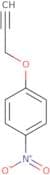
CAS 17061-85-7
:Benzene, 1-nitro-4-(2-propynyloxy)-
Description:
Benzene, 1-nitro-4-(2-propynyloxy)-, also known by its CAS number 17061-85-7, is an organic compound characterized by a benzene ring substituted with a nitro group and a propynyloxy group. The presence of the nitro group (-NO2) indicates that this compound may exhibit properties typical of nitro compounds, such as increased reactivity and potential for electrophilic substitution reactions. The propynyloxy group introduces an alkyne functionality, which can participate in various chemical reactions, including nucleophilic additions and coupling reactions. This compound is likely to be a colorless to pale yellow liquid or solid, depending on its purity and specific conditions. Its applications may span across fields such as organic synthesis, pharmaceuticals, and materials science, where it can serve as an intermediate or a building block for more complex molecules. Safety considerations are important, as nitro compounds can be hazardous, and appropriate handling and storage measures should be observed.
Formula:C9H7NO3
Sort by
Purity (%)
0
100
|
0
|
50
|
90
|
95
|
100
Found 3 products.
1-Nitro-4-(2-propynyloxy)benzene
CAS:1-Nitro-4-(2-propynyloxy)benzenePurity:97%Molecular weight:177.16g/mol1-Nitro-4-(2-propynyloxy)benzene
CAS:1-Nitro-4-(2-propynyloxy)benzene is a nitro compound that has been shown to be an effective antibacterial agent against both Gram-positive and Gram-negative bacteria. It is bimodal, with two peaks of antibacterial activity, one at low molecular weight (less than 1000 Da) and the other at higher molecular weight (greater than 1000 Da). This compound is polymerized in the presence of a catalyst such as zinc chloride, which may contribute to its antibacterial activity. Copolymerization with subtilisin increases this activity. 1-Nitro-4-(2-propynyloxy)benzene also has low toxicity for mammalian cells, including human cells. This agent inhibits growth of fungi such as Candida albicans and Aspergillus niger. 1-Nitro-4-(2-propynyloxy)benzene has been shown to inhibit bacterial DNA synthesis by binding to specificFormula:C9H7NO3Purity:Min. 95%Molecular weight:177.16 g/mol