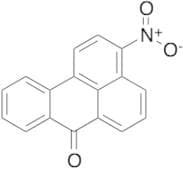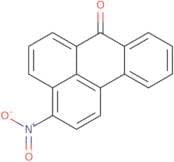
CAS 17117-34-9
:3-Nitrobenzanthrone
Description:
3-Nitrobenzanthrone is an organic compound characterized by its structure, which includes a nitro group (-NO2) attached to a benzanthrone framework. This compound typically appears as a solid and is known for its yellow to orange coloration. It is primarily used in research and as a dye intermediate due to its chromophoric properties. The presence of the nitro group contributes to its reactivity, making it a potential candidate for various chemical reactions, including electrophilic substitution. 3-Nitrobenzanthrone is also of interest in studies related to environmental chemistry, particularly concerning its potential effects as a pollutant. Its solubility can vary depending on the solvent, and it may exhibit fluorescence under certain conditions. Safety data indicates that it should be handled with care, as it may pose health risks upon exposure. Overall, 3-Nitrobenzanthrone serves as a significant compound in both industrial applications and academic research, particularly in the fields of organic chemistry and materials science.
Formula:C17H9NO3
InChI:InChI=1S/C17H9NO3/c19-17-12-5-2-1-4-10(12)11-8-9-15(18(20)21)13-6-3-7-14(17)16(11)13/h1-9H
InChI key:InChIKey=QAJOWHGESRCVLY-UHFFFAOYSA-N
SMILES:N(=O)(=O)C1=C2C3=C(C=4C(C(=O)C3=CC=C2)=CC=CC4)C=C1
Synonyms:- 3-Nitro-7H-benz(de)anthracen-7-one
- 3-Nitrobenzoanthrone
- 3-nitro-7H-benzo[de]anthracen-7-one
- 7H-Benz(de)anthracen-7-one, 3-nitro-
- Ccris 9003
- 3-Nitrobenzanthrone
Sort by
Purity (%)
0
100
|
0
|
50
|
90
|
95
|
100
Found 2 products.
3-Nitrobenzanthrone
CAS:Controlled ProductFormula:C17H9NO3Color and Shape:NeatMolecular weight:275.2583-Nitrobenzanthrone
CAS:3-Nitrobenzanthrone is a pharmacological agent that is used to induce the activation of various enzymes. It has been shown to be an effective inducer of DNA topoisomerase II, DNA gyrase, and cytochrome P450 in vivo. 3-Nitrobenzanthrone has also been shown to cause DNA adducts in hl-60 cells and dna template in vitro. These effects are observed at low doses of 3-nitrobenzanthrone and not at high doses. The carcinogenic potential of 3-nitrobenzanthrone has been studied using a rat model system and analytical methods. Low doses of nitrosamines such as 3-nitrobenzanthrone can induce cancer by forming DNA adducts, which can lead to mutations that cause uncontrolled cell growth.
Formula:C17H9NO3Purity:Min. 95%Color and Shape:Clear LiquidMolecular weight:275.26 g/molRef: 3D-FN165918
Discontinued product