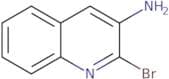
CAS 17127-83-2
:3-AMINO-2-BROMOQUINOLINE
Description:
3-Amino-2-bromoquinoline is an organic compound characterized by the presence of both an amino group and a bromo substituent on a quinoline ring system. The molecular structure features a bicyclic aromatic system, which contributes to its stability and potential reactivity. The amino group (-NH2) is typically a strong electron-donating group, enhancing the compound's nucleophilicity, while the bromo group (-Br) is an electron-withdrawing substituent that can influence the compound's reactivity in electrophilic aromatic substitution reactions. This compound may exhibit properties such as fluorescence, making it of interest in various applications, including pharmaceuticals and materials science. Additionally, the presence of both functional groups allows for potential derivatization, which can lead to the synthesis of more complex molecules. Its CAS number, 17127-83-2, is a unique identifier that facilitates the search for information regarding its properties, safety data, and applications in scientific literature and databases. Overall, 3-amino-2-bromoquinoline is a versatile compound with significant implications in organic synthesis and medicinal chemistry.
Formula:C9H7BrN2
InChI:InChI=1/C9H7BrN2/c10-9-7(11)5-6-3-1-2-4-8(6)12-9/h1-5H,11H2
SMILES:c1ccc2c(c1)cc(c(Br)n2)N
Synonyms:- 2-Bromoquinolin-3-Amine
Sort by
Purity (%)
0
100
|
0
|
50
|
90
|
95
|
100
Found 1 products.
2-Bromoquinolin-3-amine
CAS:2-Bromoquinolin-3-amine is a quinazoline alkaloid that has been modified to produce synthetic analogs. It was first synthesized in 1957 by chemical modification of the natural product quinazoline, and is used as a lead compound for the synthesis of other compounds. 2-Bromoquinolin-3-amine has shown biological activity, such as inhibition of protein synthesis in bacteria and fungi, and inhibition of DNA synthesis in human cells. It also has some antimalarial properties.Formula:C9H7BrN2Purity:Min. 95%Molecular weight:223.07 g/mol