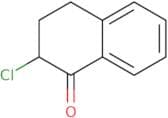
CAS 17215-80-4
:2-chloro-3,4-dihydronaphthalen-1(2H)-one
Description:
2-Chloro-3,4-dihydronaphthalen-1(2H)-one, with the CAS number 17215-80-4, is an organic compound characterized by its naphthalene structure, which is a fused bicyclic aromatic hydrocarbon. This compound features a chlorine substituent at the second position and a ketone functional group at the first position of the naphthalene ring system. The presence of the dihydro configuration indicates that it has two hydrogen atoms added to the naphthalene structure, resulting in a saturated derivative. This compound is typically a solid at room temperature and may exhibit a range of physical properties such as solubility in organic solvents. Its chemical reactivity is influenced by the presence of the chlorine atom and the carbonyl group, making it a potential candidate for various chemical reactions, including nucleophilic substitutions and reductions. Additionally, it may have applications in organic synthesis and medicinal chemistry, although specific uses would depend on further research into its biological activity and reactivity.
Formula:C10H9ClO
InChI:InChI=1/C10H9ClO/c11-9-6-5-7-3-1-2-4-8(7)10(9)12/h1-4,9H,5-6H2
SMILES:c1ccc2c(c1)CCC(C2=O)Cl
Synonyms:- 1(2H)-Naphthalenone, 2-chloro-3,4-dihydro-
- 2-chloro-3,4-dihydro-2H-naphthalen-1-one
- 2-CHLORO-3,4-DIHYDRONAPHTHALEN-1(2H)-ONE
- 2-chloro-1,2,3,4-tetrahydronaphthalen-1-one
Sort by
Purity (%)
0
100
|
0
|
50
|
90
|
95
|
100
Found 1 products.
2-Chloro-3,4-dihydronaphthalen-1(2H)-one
CAS:2-Chloro-3,4-dihydronaphthalen-1(2H)-one is a sulfoxide with significant antifungal activity. It has been shown to be effective against Candida albicans and other fungi, including Aspergillus niger and Mucor racemosus. It is commonly used as an electrolyte in electroluminescent devices, such as light emitting diodes (LEDs). The reaction time for the formation of 2-chloro-3,4-dihydronaphthalen-1(2H)-one from potassium sulfate is dependent on the acid catalyst used. Organic chemists have shown that the use of 2-chloro-3,4-dihydronaphthalen-1(2H)-one can inhibit leukotriene synthesis.
Formula:C10H9OClPurity:Min. 95%Molecular weight:180.63 g/molRef: 3D-SAA21580
Discontinued product