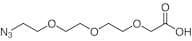
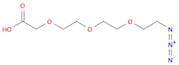
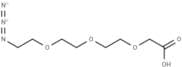
![{2-[2-(2-azidoethoxy)ethoxy]ethoxy}acetic acid](/_next/image/?url=https%3A%2Fstatic.cymitquimica.com%2Fcas-image%2Fthumb-webp%2F90232-2-2-2-azidoethoxy-ethoxy-ethoxy-acetic-acid.webp&w=3840&q=75)
CAS 172531-37-2
:{2-[2-(2-azidoethoxy)ethoxy]ethoxy}acetic acid
11-Azido-3,6,9-trioxaundecanoic Acid
CAS:Formula:C8H15N3O5Purity:>97.0%(T)Color and Shape:Light yellow to Brown clear liquidMolecular weight:233.2211-Azido-3,6,9-trioxaundecanoic Acid
CAS:Formula:C8H15N3O5Purity:97%Color and Shape:LiquidMolecular weight:233.2218Ref: IN-DA0032NY
1g132.00€5g239.00€10g607.00€25gTo inquire50gTo inquire100gTo inquire100mg57.00€250mg65.00€11-Azido-3,6,9-Trioxaundecanoic Acid
CAS:11-Azido-3,6,9-Trioxaundecanoic AcidPurity:95%Molecular weight:233.22g/mol11-carboxy-1-(diazyn-1-ium-1-yl)-4,7,10-trioxa-1-azaundecan-1-ide
CAS:Purity:95%Color and Shape:LiquidMolecular weight:233.223999N3-PEG3-CH2COOH
CAS:N3-PEG3-CH2COOH (PROTAC Linker 14) is a PEG-based compound employed in PROTAC synthesis.Formula:C8H15N3O5Purity:98%Color and Shape:SolidMolecular weight:233.2211-Azido-3,6,9-trioxaundecanoic acid
CAS:11-Azido-3,6,9-trioxaundecanoic acid is a glycan that is expressed by cancer cells. Cancer cells are able to produce 11-azido-3,6,9-trioxaundecanoic acid in response to a variety of stimuli. The compound has been shown to be an immunogenic antigen for the generation of antibodies against cancer cells. Lectins can be used to detect glycosylated proteins and glycoconjugates on cell surfaces and can also be used to immobilize them. Immobilized lectins have been used as an alternative method of detecting glycolipids and glycoconjugates on cell surfaces with high sensitivity and specificity. This glycan has been conjugated with cetuximab to target colon cancer cells. Cetuximab is a monoclonal antibody that binds specifically to the epidermal growth factor receptor (EGFR) found on the surface of many colorectal
Formula:C8H15N3O5Purity:(¹H-Nmr) Min. 95 Area-%Color and Shape:Clear LiquidMolecular weight:233.22 g/mol