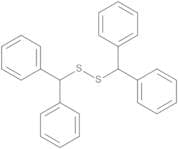
CAS 1726-02-9
:Disulfide, bis(diphenylmethyl)
Description:
Disulfide, bis(diphenylmethyl), also known by its CAS number 1726-02-9, is an organosulfur compound characterized by the presence of two diphenylmethyl groups bonded to a disulfide linkage. This compound typically appears as a solid at room temperature and is known for its stability and relatively low reactivity under standard conditions. The presence of the disulfide bond imparts unique properties, such as the ability to undergo redox reactions, which can be exploited in various chemical applications. Its structure contributes to its hydrophobic nature, making it less soluble in polar solvents while being more soluble in organic solvents. Disulfide, bis(diphenylmethyl) is often utilized in organic synthesis and materials science, particularly in the development of polymers and as a reagent in various chemical reactions. Additionally, due to its unique structural features, it may exhibit interesting electronic properties, making it a subject of study in the field of molecular electronics. Safety precautions should be observed when handling this compound, as with many organosulfur compounds, due to potential toxicity and environmental impact.
Formula:C26H22S2
Sort by
Purity (%)
0
100
|
0
|
50
|
90
|
95
|
100
Found 5 products.
Bis(diphenylmethyl)disulfide
CAS:Controlled ProductFormula:C26H22S2Color and Shape:NeatMolecular weight:398.58Dibenzhydryl disulfide
CAS:Dibenzhydryl disulfide is a compound that includes sulfide and olefinic groups. It is an impurity in the reaction products of sulfide with olefins, which may be removed by washing, distillation, and crystallization. Dibenzhydryl disulfide has been shown to react with nucleophiles (e.g., OH-, CO2) to form an anion or proton. The reaction mechanism for this product is not well understood, but it most likely proceeds through the intermediacy of diphenylmethane. The product can also undergo a transfer reaction with butyllithium or thiobenzophenone to form methylbenzene, ethylbenzene, or propylbenzene respectively.Formula:C26H22S2Purity:Min. 95%Molecular weight:398.6 g/molModafinil Related Compound E (Bis(diphenylmethyl)disulfide) (DISCONTINUED)
CAS:Other aromatic organo-sulfur compounds (excluding pesticides)Formula:C26H22S2Color and Shape:White PowderMolecular weight:398.11629