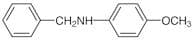
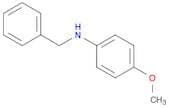
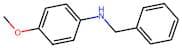
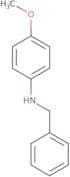
CAS 17377-95-6
:Benzylanisidine
Description:
Benzylanisidine, with the CAS number 17377-95-6, is an organic compound that features both an aniline and an anisole structure, making it a member of the substituted aniline family. It typically appears as a solid and is characterized by its aromatic properties due to the presence of benzene rings. The compound is known for its potential applications in organic synthesis, particularly in the production of dyes, pharmaceuticals, and agrochemicals. Its molecular structure includes a benzyl group attached to an anisidine moiety, which contributes to its reactivity and solubility in organic solvents. Benzylanisidine may exhibit moderate toxicity, and safety precautions should be taken when handling it, as with many aromatic amines. Additionally, it may undergo various chemical reactions, such as electrophilic substitution, due to the electron-donating nature of the methoxy group in the anisidine part of the molecule. Overall, benzylanisidine is a versatile compound with significant relevance in chemical research and industrial applications.
Formula:C14H15NO
InChI:InChI=1/C14H15NO/c1-16-14-9-7-13(8-10-14)15-11-12-5-3-2-4-6-12/h2-10,15H,11H2,1H3
SMILES:COc1ccc(cc1)NCc1ccccc1
Synonyms:- N-Benzyl-4-anisidine
- N-Benzyl-4-methoxyaniline
Sort by
Purity (%)
0
100
|
0
|
50
|
90
|
95
|
100
Found 5 products.
N-Benzyl-p-anisidine
CAS:Formula:C14H15NOPurity:>98.0%(GC)(T)Color and Shape:Light yellow to Brown powder to crystalMolecular weight:213.28BENZENEMETHANAMINE, N-(4-METHOXYPHENYL)-
CAS:Formula:C14H15NOPurity:95%Color and Shape:SolidMolecular weight:213.2750N-Benzyl-4-methoxyaniline
CAS:N-Benzyl-4-methoxyaniline is an organic compound that is used in the manufacture of dyes and pharmaceuticals. This chemical has been shown to be a substrate for glutamate dehydrogenase, which is an enzyme that converts it into 2,3-dihydroxyphenylalanine (DOPA). N-Benzyl-4-methoxyaniline also reacts with trifluoroacetic acid, generating benzaldehyde. The reaction mechanism of this molecule is nucleophilic attack by the hydroxyl group on the benzene ring.
The detection sensitivity of this compound was improved through x-ray crystal structures and FTIR spectroscopy studies. It has been shown to have a m2 phenotype, which is associated with cancer.Formula:C14H15NOPurity:Min. 95%Molecular weight:213.28 g/mol