CAS 17380-62-0
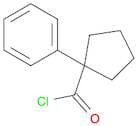
:α-Phenylcyclopentanecarbonyl chloride
Description:
α-Phenylcyclopentanecarbonyl chloride, with the CAS number 17380-62-0, is an organic compound characterized by the presence of a carbonyl chloride functional group attached to a cyclopentane ring that is further substituted with a phenyl group. This compound typically appears as a colorless to pale yellow liquid and is known for its reactivity due to the presence of the acyl chloride functional group, which makes it a useful intermediate in organic synthesis. It can participate in various chemical reactions, including nucleophilic acyl substitution, where it can react with amines, alcohols, or other nucleophiles to form corresponding amides or esters. The compound's structure contributes to its unique properties, such as its boiling point and solubility characteristics, which are influenced by the steric and electronic effects of the phenyl and cyclopentane moieties. Safety precautions are necessary when handling this compound, as it can be corrosive and may release harmful gases upon reaction with water or moisture.
Sort by
Purity (%)
0
100
|
0
|
50
|
90
|
95
|
100
Found 2 products.
1-Phenylcyclopentanecarbonyl chloride
CAS:1-Phenylcyclopentanecarbonyl chloride is an aliphatic compound with a chlorine atom. It is soluble in water and has a solubility of 4.6 g/L at room temperature. 1-Phenylcyclopentanecarbonyl chloride is used as a precursor to produce bioplastics, such as poly(1-phenylcyclopentane)chloride and poly(1,2-diphenylethylene)chloride. This compound can also be used to disrupt cell membranes by reacting with the chloride ion on the outside of the membrane, which lowers its permeability. 1-Phenylcyclopentanecarbonyl chloride reacts with moieties in organic compounds, such as aliphatic and cycloaliphatic moieties, to form covalently bonded chlorides that are less reactive than their corresponding hydrochlorides or other halides. The lower reactivity of these chlorides allows them toFormula:C12H13ClOPurity:Min. 95%Molecular weight:208.68 g/molRef: 3D-SAA38062
Discontinued product