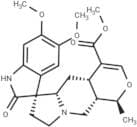
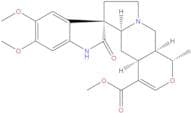
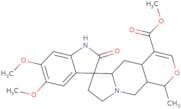
![Spiro[3H-indole-3,6'(4'aH)-[1H]pyrano[3,4-f]indolizine]-4'-carboxylicacid, 1,2,5',5'a,7',8',10',10…](/_next/image/?url=https%3A%2Fstatic.cymitquimica.com%2Fcas-image%2Fthumb-webp%2F346274-spiro-3h-indole-36-4-ah-1h-pyrano-34-f-indolizine-4-carboxylicacid-125-5-a-7-8-10-10-a-octahydro-56-dimethoxy-1-methyl-2-oxo-methyl-ester-1-s-3s-4-as-5-as-10-as.webp&w=3840&q=75)
CAS 17391-09-2
:Spiro[3H-indole-3,6'(4'aH)-[1H]pyrano[3,4-f]indolizine]-4'-carboxylicacid, 1,2,5',5'a,7',8',10',10'a-octahydro-5,6-dimethoxy-1'-methyl-2-oxo-,methyl ester, (1'S,3S,4'aS,5'aS,10'aS)-
Description:
Spiro[3H-indole-3,6'(4'aH)-[1H]pyrano[3,4-f]indolizine]-4'-carboxylic acid, 1,2,5',5'a,7',8',10',10'a-octahydro-5,6-dimethoxy-1'-methyl-2-oxo-, methyl ester, with CAS number 17391-09-2, is a complex organic compound characterized by its unique spirocyclic structure that incorporates both indole and pyranoindolizine moieties. This compound features multiple functional groups, including a carboxylic acid and a methyl ester, which contribute to its chemical reactivity and potential biological activity. The presence of methoxy groups enhances its solubility and may influence its pharmacological properties. The stereochemistry indicated by the (1'S,3S,4'aS,5'aS,10'aS) designation suggests specific spatial arrangements of atoms, which can significantly affect the compound's interactions with biological targets. Overall, this substance is of interest in medicinal chemistry and may exhibit various biological activities, making it a candidate for further research in drug development and therapeutic applications.
Formula:C23H28N2O6
Synonyms:- 7-Isocarapanaubine
- Formosanan-16-carboxylic acid, 10,11-dimethoxy-19-methyl-2-oxo-, methylester, (7a,19a,20a)-
- Isocarapanaubine
- Spiro[3H-indole-3,6'(4'aH)-[1H]pyrano[3,4-f]indolizine]-4'-carboxylic acid,1,2,5',5'a,7',8',10',10'a-octahydro-5,6-dimethoxy-1'-methyl-2-oxo-, methylester, [1'S-(1'a,4'aa,5'aa,6'a,10'aa)]-
Sort by
Purity (%)
0
100
|
0
|
50
|
90
|
95
|
100
Found 4 products.
Isocarapanaubine
CAS:Isocarapanaubine and reserpiline are cytotoxic constituents from the barks of Ochrosia elliptica.Formula:C23H28N2O6Purity:98%Color and Shape:SolidMolecular weight:428.48Isocarapanaubine
CAS:Isocarapanaubine is an alkaloid, which is a naturally occurring compound primarily sourced from certain plant species within the rainforest ecosystems known for their diverse chemical constituents. Its mode of action involves interaction with specific neural pathways and receptors, suggesting potential modulation of neurotransmitter systems. This mechanism could elucidate various pharmacological effects, making it a vital subject of study for drug development and medicinal chemistry.
Formula:C23H28N2O6Purity:Min. 95%Molecular weight:428.5 g/molRef: 3D-SAA39109
Discontinued product