CAS 1746-77-6
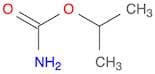
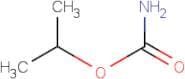
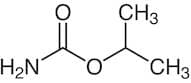
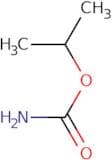
:Propan-2-yl carbamate
Description:
Propan-2-yl carbamate, also known as isopropyl carbamate, is an organic compound characterized by its carbamate functional group, which consists of a carbonyl group (C=O) bonded to a nitrogen atom (N) that is also connected to an isopropyl group (C3H7). This compound typically appears as a colorless to pale yellow liquid with a faint odor. It is soluble in water and various organic solvents, making it versatile for different applications. Propan-2-yl carbamate is primarily used in the synthesis of pharmaceuticals and agrochemicals, serving as an intermediate in the production of other chemical compounds. Its chemical stability and relatively low toxicity contribute to its utility in industrial processes. However, as with many carbamates, it is essential to handle it with care due to potential health effects associated with exposure. Overall, propan-2-yl carbamate is a valuable compound in organic chemistry, with applications that leverage its unique chemical properties.
Formula:C4H9NO2
InChI:InChI=1S/C4H9NO2/c1-3(2)7-4(5)6/h3H,1-2H3,(H2,5,6)
InChI key:InChIKey=OVPLZYJGTGDFNB-UHFFFAOYSA-N
SMILES:O(C(C)C)C(N)=O
Synonyms:- 1-Methylethyl carbamate
- Carbamic acid isopropyl ester
- Carbamic acid, 1-methylethyl ester
- NSC 60539
- Propan-2-yl carbamate
- Isopropyl carbamate
Sort by
Purity (%)
0
100
|
0
|
50
|
90
|
95
|
100
Found 6 products.
Carbamic acid, 1-methylethyl ester
CAS:Formula:C4H9NO2Purity:97%Color and Shape:SolidMolecular weight:103.1198Carbamic acid isopropyl ester
CAS:Carbamic acid isopropyl esterPurity:97%Molecular weight:103.12g/molIsopropyl Carbamate
CAS:Formula:C4H9NO2Purity:>98.0%(GC)(N)Color and Shape:White to Almost white powder to crystalMolecular weight:103.12Carbamic acid isopropyl ester
CAS:Carbamic acid isopropyl ester (CiPA) is a drug that is used to treat metabolic disorders and autoimmune diseases. It has been shown to be effective in clinical trials for the treatment of chronic schizophrenia and psychotic disorder. CiPA inhibits the activity of lysine residues on proteins, which are involved in the metabolism of amino acids. It also binds to amide groups and carbonyl groups on proteins, leading to inhibition of protein synthesis and other biological processes. The pharmacokinetic properties of CiPA are thought to be due to its ability to inhibit liver cells, which can lead to an increase in the elimination rate of this drug from the body.Formula:C4H9NO2Purity:Min. 95%Molecular weight:103.12 g/mol