CAS 175137-25-4
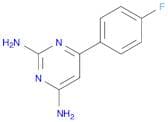
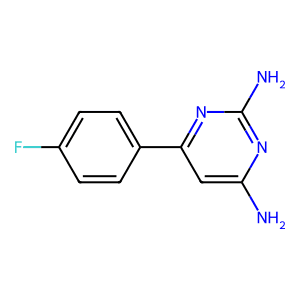
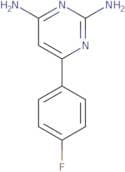
:2,4-Diamino-6-(4-fluorophenyl)pyrimidine
Description:
2,4-Diamino-6-(4-fluorophenyl)pyrimidine is a chemical compound characterized by its pyrimidine ring structure, which is substituted at the 2 and 4 positions with amino groups and at the 6 position with a 4-fluorophenyl group. This compound is typically a solid at room temperature and is soluble in polar solvents, reflecting its polar functional groups. It exhibits properties typical of amino-substituted pyrimidines, including potential biological activity, which may be of interest in pharmaceutical research. The presence of the fluorine atom can enhance lipophilicity and influence the compound's interaction with biological targets. Its molecular structure allows for various chemical reactions, making it a versatile intermediate in organic synthesis. Additionally, the compound may exhibit specific pharmacological properties, which could be explored for therapeutic applications. As with many chemical substances, safety data should be consulted to understand its handling and potential hazards.
Formula:C7H7F3N4O2
InChI:InChI=1/C7H7F3N4O2/c1-16-5(15)3-2-12-6(14-11)13-4(3)7(8,9)10/h2H,11H2,1H3,(H,12,13,14)
SMILES:COC(=O)c1cnc(nc1C(F)(F)F)NN
Synonyms:- Methyl 2-Hydrazino-4-(Trifluoromethyl)Pyrimidine-5-Carboxylate
Sort by
Purity (%)
0
100
|
0
|
50
|
90
|
95
|
100
Found 4 products.
6-(4-Fluorophenyl)pyrimidine-2,4-diamine
CAS:Formula:C10H9FN4Color and Shape:SolidMolecular weight:204.20372,4-Diamino-6-(4-fluorophenyl)pyrimidine
CAS:2,4-Diamino-6-(4-fluorophenyl)pyrimidinePurity:97%Color and Shape:SolidMolecular weight:204.20g/mol2,4-Diamino-6-(4-fluorophenyl)pyrimidine
CAS:Formula:C10H9FN4Purity:95.0%Color and Shape:SolidMolecular weight:204.2086-(4-Fluorophenyl)pyrimidine-2,4-diamine
CAS:6-(4-Fluorophenyl)pyrimidine-2,4-diamine is an organic compound that has been shown to inhibit the proliferation of cells in vitro and to induce apoptosis. It also inhibits the growth of cancer cells. 6-(4-Fluorophenyl)pyrimidine-2,4-diamine mediates the activation of arylation, which is a chemical reaction that produces a new carbon-carbon bond between two or more molecules. This reaction is involved in the process of angiogenesis. In addition, this compound has been shown to be reactive with other compounds that are known to cause mutations and cellular damage.Formula:C10H9FN4Purity:Min. 95%Molecular weight:204.2 g/mol