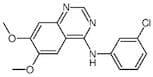
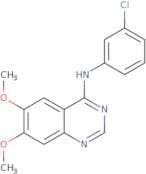
CAS 175178-82-2
:N-(3-Chlorophenyl)-6,7-dimethoxy-4-quinazolinamine
Description:
N-(3-Chlorophenyl)-6,7-dimethoxy-4-quinazolinamine is a chemical compound characterized by its quinazoline core structure, which is a bicyclic compound containing a benzene ring fused to a pyrimidine ring. This particular compound features a 3-chlorophenyl group, which introduces a chlorine atom at the para position of the phenyl ring, influencing its electronic properties and potentially its biological activity. The presence of two methoxy groups at the 6 and 7 positions of the quinazoline ring enhances its solubility and may affect its interaction with biological targets. The compound is of interest in medicinal chemistry, particularly for its potential pharmacological properties, including anti-cancer and anti-inflammatory activities. Its molecular structure allows for various interactions with biological macromolecules, making it a candidate for further research in drug development. As with many quinazoline derivatives, the specific characteristics such as solubility, stability, and reactivity can vary based on the substituents and their positions on the ring system.
Formula:C16H14ClN3O2
InChI:InChI=1S/C16H14ClN3O2/c1-21-14-7-12-13(8-15(14)22-2)18-9-19-16(12)20-11-5-3-4-10(17)6-11/h3-9H,1-2H3,(H,18,19,20)
InChI key:InChIKey=GFNNBHLJANVSQV-UHFFFAOYSA-N
SMILES:N(C=1C2=C(C=C(OC)C(OC)=C2)N=CN1)C3=CC(Cl)=CC=C3
Synonyms:- Tyrphostin AG 1478
- N-(3-Chlorophenyl)-6,7-dimethoxy-4-quinazolinamine
- AG 1478
- NSC 693255
- 4-Quinazolinamine, N-(3-chlorophenyl)-6,7-dimethoxy-
Sort by
Purity (%)
0
100
|
0
|
50
|
90
|
95
|
100
Found 3 products.
Tyrphostin AG 1478
CAS:Controlled Product<p>Applications Tyrphostin AG 1478 is a potent and selective inhibitor of EGFR.<br></p>Formula:C16H14ClN3O2Color and Shape:NeatMolecular weight:315.75InSolution AG 1478
CAS:<p>InSolution AG 1478 is a tyrosine kinase inhibitor that binds to the ATP-binding site of tyrosine kinases. In vitro studies have shown that it inhibits the activation of epidermal growth factor receptor and nerve growth factor receptors, and blocks epidermal growth factor (EGF) and nerve growth factor (NGF) induced phosphorylation in mouse epidermal cells. In vivo animal studies show that this drug has an effect on axonal growth and promotes nerve regeneration. In vitro studies also show that it inhibits DNA binding activity in response to EGF or NGF.</p>Formula:C16H14ClN3O2Purity:Min. 95%Molecular weight:315.75 g/mol