CAS 17567-17-8
:Potassium hydrotris(3,5-dimethylpyrazolyl)borate
Description:
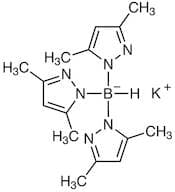
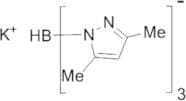
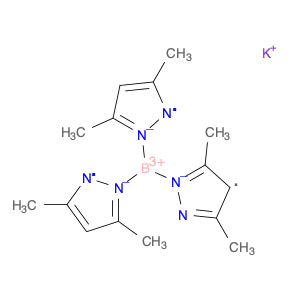
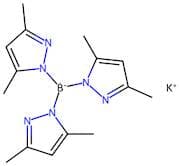
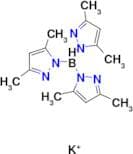
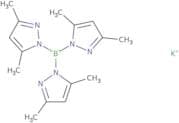
Potassium hydrotris(3,5-dimethylpyrazolyl)borate, commonly referred to as K[HB(3,5-DMP)3], is a coordination compound featuring a boron center coordinated to three 3,5-dimethylpyrazole ligands. This compound is characterized by its unique structure, where the boron atom is stabilized by the presence of the pyrazole rings, which contribute to its chelating properties. The potassium ion serves as a counterion, balancing the negative charge of the borate complex. This substance is known for its role in various chemical reactions, particularly in the field of organometallic chemistry and catalysis, where it can act as a ligand for transition metals. It exhibits good solubility in polar solvents and is relatively stable under standard laboratory conditions. The presence of the dimethyl groups on the pyrazole rings enhances the steric bulk around the boron center, influencing its reactivity and interaction with other chemical species. Overall, potassium hydrotris(3,5-dimethylpyrazolyl)borate is a valuable compound in synthetic chemistry, particularly in the development of new catalytic systems.
Formula:C15H22BKN6
InChI:InChI=1/C15H22BN6.K/c1-10-7-13(4)20(17-10)16(21-14(5)8-11(2)18-21)22-15(6)9-12(3)19-22;/h7-9,16H,1-6H3;/q-1;+1
InChI key:InChIKey=NTWZGFNSHCFHIJ-UHFFFAOYSA-N
SMILES:[B+3]([H-])([N-]1C(C)=CC(C)=N1)([N-]2C(C)=CC(C)=N2)[N-]3C(C)=CC(C)=N3.[K+]
Synonyms:- 1H-Pyrazole, 3,5-dimethyl-, boron complex
- Borate(1-), tris(3,5-dimethyl-1H-pyrazolato-N<sup>1</sup>)hydro-, potassium, (T-4)-
- Borate(1-), tris(3,5-dimethyl-1H-pyrazolato-κN<sup>1</sup>)hydro-, potassium, (T-4)-
- Borate(1-), tris(3,5-dimethylpyrazolato)hydro-, potassium
- NSC 376448
- Potassium Tris(3,5-Dimethyl-1-Pyrazolyl)-Borohydride
- Potassium Tris(3,5-Dimethylpyrazol-1-Yl)Borohydride
- Potassium hydridotris(3,5-dimethylpyrazol-1-yl)borate
- Potassium hydridotris(3,5-dimethylpyrazolyl)borate(1-)
- Potassium hydridotris-(3,5-dimethylpyrazolyl)borate
- Potassium hydrotris(3,5-dimethyl-1H-pyrazol-1-yl)borate
- Potassium hydrotris(3,5-dimethyl-1H-pyrazol-1-yl)borate(1-)
- Potassium hydrotris(3,5-dimethylpyrazol-1-yl)borate(1-)
- Potassium hydrotris(3,5-dimethylpyrazolyl)borate
- Potassium hydrotris(3,5-dimethylpyrazolyl)borate(1-)
- Potassium tri(3,5-dimethyl-1-pyrazolyl)borohydride
- Potassium tris(3,5-dimethylpyrazol-1-yl)hydroborate
- Potassium tris(3,5-dimethylpyrazolyl)hydroborate
- Potassiumhydrotris(3,5-dimethylpyrazol-1-yl)borate,97%
- potassium tris(3,5-dimethyl-1H-pyrazol-1-yl)(hydrido)borate(1-)
- Borate(1-), tris(3,5-dimethyl-1H-pyrazolato-N1)hydro-, potassium, (T-4)-
- Borate(1-), tris(3,5-dimethyl-1H-pyrazolato-κN1)hydro-, potassium, (T-4)-
- Scorpionates
- Potassium tris(3,5-dimethyl-1-pyrazolyl)borohydride,99%
- POTASSIUM HYDROTRIS(3,5-DIMETHYLPYRAZOL-1-YL)BORATE
- Tp ligand
- See more synonyms
Sort by
Purity (%)
0
100
|
0
|
50
|
90
|
95
|
100
Found 6 products.
Potassium Tris(3,5-dimethylpyrazol-1-yl)borohydride
CAS:Formula:C15H22BKN6Purity:>98.0%(T)Color and Shape:White to Almost white powder to crystalMolecular weight:336.29Potassium hydrotris(3,5-dimethylpyrazol-1-yl)borate, 97%
CAS:Potassium hydrotris(3,5-dimethylpyrazol-1-yl)borate, 97%
Formula:C15H22BN6KPurity:97%Color and Shape:white pwdr.Molecular weight:336.29POTASSIUM HYDROTRIS(3,5-DIMETHYLPYRAZOL-1-YL)BORATE
CAS:Formula:C15H22BKN6Purity:98%Color and Shape:SolidMolecular weight:336.2847Potassiumhydrotris(3,5-Dimethylpyrazol-1-Yl)Borate
CAS:Potassiumhydrotris(3,5-Dimethylpyrazol-1-Yl)BoratePurity:98%Molecular weight:336.28g/molPotassium tris(3,5-dimethyl-1-pyrazolyl)borohydride
CAS:Purity:98.0%Color and Shape:SolidMolecular weight:336.29Potassium tris(3,5-dimethyl-1-pyrazolyl)borohydride
CAS:Potassium tris(3,5-dimethyl-1-pyrazolyl)borohydride is a catalytic reagent that converts various ketones to their corresponding cyclic 3,5-dimethylpyrazoles. It has been used for the synthesis of 1,4-dihydropyridines and for the conversion of aliphatic nitro compounds to their corresponding anilines. The yields are high and it has been shown to be more efficient than other methods in the literature. This reagent also has an intramolecular reaction mechanism and is able to reduce chloride ions into chloride gas.Formula:C15H22BKN6Purity:Min. 95%Color and Shape:PowderMolecular weight:336.28 g/mol