CAS 175854-39-4
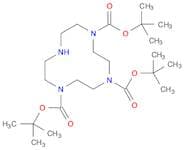
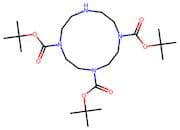
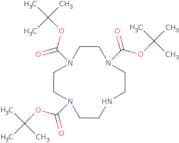
:1,4,7-tris-Boc-1,4,7,10-tetraaza-cyclododecane
Description:
1,4,7-Tris-Boc-1,4,7,10-tetraaza-cyclododecane is a synthetic organic compound characterized by its unique cyclic structure and multiple nitrogen atoms. The "Boc" (tert-butyloxycarbonyl) groups indicate that the compound has three protective groups attached to the nitrogen atoms, which are commonly used in organic synthesis to protect amines during chemical reactions. This compound features a cyclododecane framework, which consists of twelve carbon atoms arranged in a ring, with four nitrogen atoms incorporated into the structure, contributing to its tetraaza designation. The presence of these nitrogen atoms allows for potential coordination with metal ions, making it of interest in coordination chemistry and catalysis. Additionally, the Boc groups enhance the solubility and stability of the compound in various solvents, facilitating its use in synthetic applications. Overall, 1,4,7-tris-Boc-1,4,7,10-tetraaza-cyclododecane is a versatile compound with significant implications in medicinal chemistry and materials science.
Formula:C23H44N4O6
InChI:InChI=1/C23H44N4O6/c1-21(2,3)18(28)33-27-13-11-24-10-12-25(19(29)31-22(4,5)6)14-15-26(16-17-27)20(30)32-23(7,8)9/h24H,10-17H2,1-9H3
SMILES:CC(C)(C)C(=O)ON1CCNCCN(CCN(CC1)C(=O)OC(C)(C)C)C(=O)OC(C)(C)C
Synonyms:- 1,4,7-Tri-Boc-1,4,7,10-tetraazacyclododecane
- Ditert-Butyl 7-(2,2-Dimethylpropanoyloxy)-1,4,7,10-Tetrazacyclododecane-1,4-Dicarboxylate
Sort by
Purity (%)
0
100
|
0
|
50
|
90
|
95
|
100
Found 4 products.
1,4,7,10-Tetraazacyclododecane-1,4,7-tricarboxylic acid, 1,4,7-tris(1,1-dimethylethyl) ester
CAS:Formula:C23H44N4O6Purity:95%Color and Shape:SolidMolecular weight:472.61871,4,7-Tri-Boc-1,4,7,10-Tetraazacyclododecane
CAS:1,4,7-Tri-Boc-1,4,7,10-TetraazacyclododecanePurity:97%Molecular weight:472.62g/mol1,4,7-tri-Boc-1,4,7,10-tetraaza-cyclododecane
CAS:Cyclen is a polycyclic macrocycle that is synthesized by the reaction of 1,4,7-tri-Boc-1,4,7,10-tetraaza-cyclododecane with copper(II) acetate. Cyclen has shown inhibitory activity against copper ion in the presence of hydrogen peroxide. Cyclen also inhibits the growth of cancer cells and hybridizes with messenger RNA in a zn2+ ion. The thermal denaturation of cyclen has been studied using UV spectroscopy and differential scanning calorimetry methods. Cyclen dissociates rapidly from metal ions in aqueous solution at room temperature when exposed to UV light.Formula:C23H44N4O6Purity:Min. 95%Color and Shape:White PowderMolecular weight:472.62 g/mol