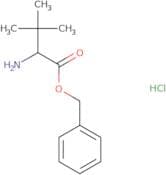
CAS 176388-88-8
:L-Valine, 3-methyl-, phenylmethyl ester, hydrochloride
Description:
L-Valine, 3-methyl-, phenylmethyl ester, hydrochloride is a chemical compound that belongs to the class of amino acid derivatives. It is a hydrochloride salt, which indicates that it is a protonated form of the ester, enhancing its solubility in water. The compound features a branched-chain amino acid, L-Valine, which is essential for protein synthesis and plays a crucial role in muscle metabolism. The presence of the phenylmethyl (benzyl) ester group suggests that it may exhibit unique properties, such as increased lipophilicity, which can influence its bioavailability and pharmacokinetics. The hydrochloride form typically enhances stability and solubility in aqueous solutions, making it suitable for various applications in biochemistry and pharmaceuticals. As with many amino acid derivatives, it may have implications in nutritional supplementation, therapeutic formulations, or as a building block in peptide synthesis. Overall, this compound's characteristics make it of interest in both research and potential therapeutic contexts.
Formula:C13H19NO2ClH
Sort by
Purity (%)
0
100
|
0
|
50
|
90
|
95
|
100
Found 1 products.
Benzyl (2S)-2-amino-3,3-dimethylbutanoate hydrochloride
CAS:Benzyl (2S)-2-amino-3,3-dimethylbutanoate hydrochloride is an inhibitor that can be used in the synthesis of amides. It is a racemic mixture of two enantiomers: erythro and threo. This product is also useful as an intermediate for organic synthesis. The product is stable to hydrolysis by acid or base at room temperature and pressure. The yield is not affected by the stereogenic center, but it does decrease when coupling reactions are involved. Benzyl 2S-2-amino-3,3-dimethylbutanoate hydrochloride reacts with amines to form amides, which are intermediates in organic synthesis. This compound also inhibits matrix metalloproteases and matrix metalloprotease activity.Formula:C13H20ClNO2Purity:Min. 95%Molecular weight:257.75 g/mol