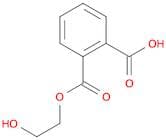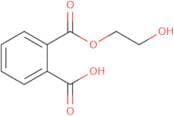
CAS 17689-42-8
:1,2-Benzenedicarboxylic acid, 1-(2-hydroxyethyl) ester
Description:
1,2-Benzenedicarboxylic acid, 1-(2-hydroxyethyl) ester, commonly known as diethyl phthalate, is an organic compound characterized by its ester functional groups derived from phthalic acid. It appears as a colorless to pale yellow liquid with a faint aromatic odor. This compound is soluble in organic solvents but has limited solubility in water, which is typical for many esters. It is primarily used as a plasticizer in the production of flexible plastics, enhancing their durability and flexibility. Additionally, it serves as a solvent in various applications, including cosmetics and personal care products. The compound exhibits low volatility and is relatively stable under normal conditions, although it can undergo hydrolysis in the presence of strong acids or bases. Safety data indicates that while it is generally considered to have low toxicity, prolonged exposure may lead to health concerns, necessitating appropriate handling measures. Overall, 1,2-Benzenedicarboxylic acid, 1-(2-hydroxyethyl) ester plays a significant role in industrial applications, particularly in the manufacturing of polymers.
Formula:C10H10O5
InChI:InChI=1/C10H10O5/c11-5-6-15-10(14)8-4-2-1-3-7(8)9(12)13/h1-4,11H,5-6H2,(H,12,13)
InChI key:InChIKey=NTINFTOOVNKGIU-UHFFFAOYSA-N
SMILES:C(OCCO)(=O)C1=C(C(O)=O)C=CC=C1
Synonyms:- 1,2-Benzenedicarboxylic acid, 1-(2-hydroxyethyl) ester
- Phthalic acid, mono(2-hydroxyethyl) ester
- Ethylene glycol, mono(hydrogen phthalate)
- 2-Hydroxyethyl hydrogen phthalate
- 1,2-Benzenedicarboxylic acid, mono(2-hydroxyethyl) ester
- Phthalic acid, 2-hydroxyethyl ester
- 2-[(2-hydroxyethoxy)carbonyl]benzoic acid
Sort by
Purity (%)
0
100
|
0
|
50
|
90
|
95
|
100
Found 4 products.
1,2-Benzenedicarboxylic acid, 1-(2-hydroxyethyl) ester
CAS:Formula:C10H10O5Purity:97%Color and Shape:SolidMolecular weight:210.18342-((2-Hydroxyethoxy)carbonyl)benzoic acid
CAS:2-((2-Hydroxyethoxy)carbonyl)benzoic acid (HECA) is a reactive and catalytic ligand that can be used to study the kinetics and mechanism of transition metal catalyzed reactions. HECA binds to transition metals such as nickel, palladium, platinum, and copper. It is also a ligand for alkoxides and alcohols. HECA has been shown to be an effective catalyst in organic synthesis, including the catalysis of oxidative addition reactions.Formula:C10H10O5Purity:Min. 95%Molecular weight:210.18 g/mol