CAS 17720-64-8
:2-(Acetyloxy)-1H-isoindole-1,3(2H)-dione
Description:
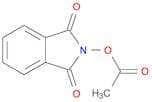
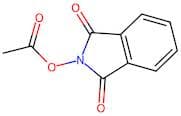
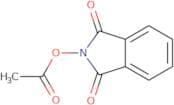
2-(Acetyloxy)-1H-isoindole-1,3(2H)-dione, also known by its CAS number 17720-64-8, is a chemical compound characterized by its isoindole structure, which features a fused benzene and pyrrole ring system. This compound contains an acetyloxy group, contributing to its reactivity and potential applications in organic synthesis. It typically appears as a solid at room temperature and is soluble in organic solvents, reflecting its non-polar characteristics. The presence of the dione functional groups indicates that it can participate in various chemical reactions, such as nucleophilic additions and condensation reactions. Its unique structure allows it to exhibit biological activity, making it of interest in medicinal chemistry. Additionally, the compound may be sensitive to light and moisture, necessitating careful handling and storage conditions. Overall, 2-(Acetyloxy)-1H-isoindole-1,3(2H)-dione is a versatile compound with potential applications in pharmaceuticals and organic synthesis.
Formula:C10H7NO4
InChI:InChI=1S/C10H7NO4/c1-6(12)15-11-9(13)7-4-2-3-5-8(7)10(11)14/h2-5H,1H3
InChI key:InChIKey=IJRNYIWWGDQEIY-UHFFFAOYSA-N
SMILES:O=C1C=2C(C(=O)N1OC(C)=O)=CC=CC2
Synonyms:- 2-(Acetyloxy)-1H-isoindole-1,3(2H)-dione
- NSC 101749
- N-Acetoxyphthalimide
- Phthalimide, N-acetoxy-
- 1H-Isoindole-1,3(2H)-dione, 2-(acetyloxy)-
Sort by
Purity (%)
0
100
|
0
|
50
|
90
|
95
|
100
Found 4 products.
1H-Isoindole-1,3(2H)-dione, 2-(acetyloxy)-
CAS:Formula:C10H7NO4Purity:97%Color and Shape:SolidMolecular weight:205.16691,3-Dioxoisoindolin-2-yl acetate
CAS:1,3-Dioxoisoindolin-2-yl acetatePurity:98%Molecular weight:205.17g/mol1,3-Dioxo-2,3-dihydro-1H-isoindol-2-yl acetate
CAS:1,3-Dioxo-2,3-dihydro-1H-isoindol-2-yl acetate is a reactive intermediate that can be used as a starting material for the synthesis of other organic compounds. It is synthesized by the reaction of an acid with an aldehyde or ketone in the presence of a base. The rate of this reaction depends on the functional groups present in both reactants and their relative concentrations. This intermediate can be converted to another chemical compound through various reactions, including hydroxymethylation, decarboxylation and oxidation. This chemical has been used as a cocatalyst for the production of 5-hydroxymethylfurfural (HMF).Formula:C10H7NO4Purity:Min. 95%Molecular weight:205.17 g/mol