CAS 1776-09-6
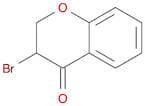
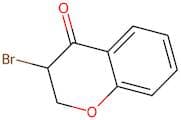
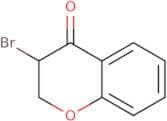
:4H-1-Benzopyran-4-one, 3-bromo-2,3-dihydro-
Description:
4H-1-Benzopyran-4-one, 3-bromo-2,3-dihydro- is an organic compound characterized by its fused benzopyran structure, which consists of a benzene ring fused to a pyran ring containing a carbonyl group. This compound features a bromine substituent at the 3-position of the benzopyran structure, contributing to its reactivity and potential applications in various chemical reactions. The presence of the dihydro group indicates that the compound has two additional hydrogen atoms, suggesting it is in a saturated form compared to its fully unsaturated counterparts. This compound may exhibit biological activity, making it of interest in medicinal chemistry and pharmacology. Its properties, such as solubility, melting point, and stability, can vary based on the presence of the bromine atom and the overall molecular structure. As with many organic compounds, it is essential to handle it with care, considering potential hazards associated with brominated compounds. Overall, 4H-1-Benzopyran-4-one, 3-bromo-2,3-dihydro- represents a unique structure with potential applications in various fields of chemistry.
Formula:C9H7BrO2
Sort by
Purity (%)
0
100
|
0
|
50
|
90
|
95
|
100
Found 4 products.
3-Bromo-2,3-dihydro-4H-chromen-4-one
CAS:3-Bromo-2,3-dihydro-4H-chromen-4-onePurity:95%Molecular weight:227.06g/mol3-bromo-2,3-dihydro-4H-chromen-4-one
CAS:3-Bromo-2,3-dihydro-4H-chromen-4-one is a borohydride reduction and molecular modeling study of an analog of the natural product. The 14α-demethylase enzyme catalyzes the conversion of 3β,14α-dihydroxyandrostane to 3β,14β-dihydroxyandrostane. This enzyme has stereoselective activity in the synthesis of androgens from progesterone. The hydrogen bond interactions between the active site residues and solvent molecules are important for the enzymatic activity.
Formula:C9H7BrO2Purity:Min. 95%Molecular weight:227.06 g/molRef: 3D-BAA77609
Discontinued product