CAS 1782573-49-2
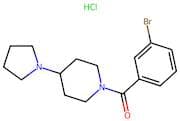
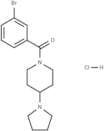
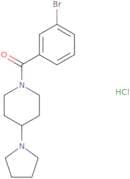
:(3-bromophenyl)-(4-pyrrolidin-1-ylpiperidin-1-yl)methanone:hydrochloride
Description:
(3-bromophenyl)-(4-pyrrolidin-1-ylpiperidin-1-yl)methanone hydrochloride is a synthetic compound characterized by its complex structure, which includes a bromophenyl group and a piperidine derivative. This compound typically exhibits properties associated with both aromatic and aliphatic systems, contributing to its potential biological activity. The presence of the bromine atom may enhance lipophilicity and influence the compound's interaction with biological targets. As a hydrochloride salt, it is likely to be more soluble in water compared to its free base form, which can facilitate its use in various applications, including pharmacological research. The compound may exhibit psychoactive properties, given its structural components, which are often associated with central nervous system activity. Safety and handling precautions are essential, as with any chemical substance, particularly those with potential biological effects. Further studies would be necessary to fully elucidate its pharmacodynamics, pharmacokinetics, and potential therapeutic applications.
Formula:C16H22BrClN2O
Synonyms:- (3-bromophenyl)-(4-pyrrolidin-1-ylpiperidin-1-yl)methanone:hydrochloride
- UNC926,methyl-lysine,L3MBTL3,Epigenetic Reader Domain,UNC-926 hydrochloride,UNC926 hydrochloride,L3MBTL1,Inhibitor,inhibit,3xMBT,UNC-926,UNC 926,H4K20me1
Sort by
Purity (%)
0
100
|
0
|
50
|
90
|
95
|
100
Found 3 products.
UNC926 hydrochloride
CAS:UNC926 hydrochloride is a methyl-lysine (Kme) reader domain inhibitor.Formula:C16H22BrClN2OPurity:99.93%Color and Shape:SolidMolecular weight:373.72Ref: TM-T9221
1mg84.00€5mg168.00€10mg245.00€25mg404.00€50mg567.00€100mg767.00€200mg1,018.00€1mL*10mM (DMSO)168.00€Unc-926 hydrochloride
CAS:Unc-926 is a pluripotent stem cell (PSC) that can differentiate into cells from all three germ layers. Unc-926 cells have been shown to be glucose-dependent and utilize the mitochondrial respiratory chain for respiration. These cells are capable of differentiating into insulin-producing beta cells and pancreatic islet cells, which can be used in the treatment of diabetes.
Formula:C16H22BrClN2OPurity:Min. 95%Molecular weight:373.7 g/mol