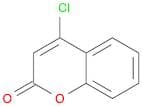
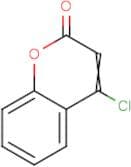
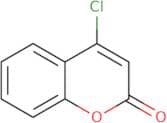
CAS 17831-88-8
:4-chloro-2H-1-benzopyran-2-one
- 2H-1-Benzopyran-2-one, 4-chloro-
- 4-Chlorocoumarin
- 4-chloro-2H-chromen-2-one
- Coumarin, 4-chloro-
- NSC 74867
- 4-Chloro-2H-1-benzopyran-2-one
2H-1-Benzopyran-2-one, 4-chloro-
CAS:Formula:C9H5ClO2Purity:98%Color and Shape:SolidMolecular weight:180.58784-Chloro-2H-chromen-2-one
CAS:4-Chloro-2H-chromen-2-onePurity:>98%Color and Shape:SolidMolecular weight:180.59g/mol4-Chloro-2H-chromen-2-one
CAS:4-Chloro-2H-chromen-2-one is an organic compound that is used as a building block in the synthesis of coumarin derivatives. It undergoes nucleophilic substitution reactions with amines, forming 4-hydroxycoumarin. This reaction is catalyzed by organometallic compounds such as PdCl2 and Cu(OAc)2. Cross-coupling reactions have been shown to be effective for the synthesis of coumarin derivatives. The mechanism of this reaction involves oxidative addition of an organometallic reagent to the carbon atom, followed by elimination of water to form an intermediate epoxide. Deuteration is required for this reaction because hydrogen reacts too rapidly with the organometallic reagents to be useful in the coupling process. 4-Chloro-2H-chromen-2-one has been shown to react with other nucleophiles such as thiols, phenols, and alcohols at
Formula:C9H5ClO2Purity:Min. 95%Molecular weight:180.59 g/mol