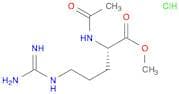
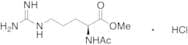
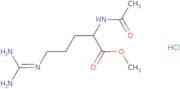
CAS 1784-05-0
:L-Arginine, N2-acetyl-, methyl ester, hydrochloride (1:1)
Description:
L-Arginine, N2-acetyl-, methyl ester, hydrochloride (1:1) is a derivative of the amino acid L-arginine, which plays a crucial role in various physiological processes, including protein synthesis and nitric oxide production. This compound features an acetyl group and a methyl ester modification, enhancing its solubility and bioavailability. As a hydrochloride salt, it is typically more stable and easier to handle in laboratory and pharmaceutical settings. The presence of the methyl ester group may influence its pharmacokinetics, potentially allowing for improved absorption and transport across cell membranes. L-arginine derivatives are often studied for their potential therapeutic applications, including cardiovascular health, immune function, and wound healing. Additionally, this compound may exhibit different biological activities compared to its parent amino acid, making it of interest in research related to metabolic pathways and drug development. As with any chemical substance, proper handling and safety precautions are essential, given its potential biological effects and interactions.
Formula:C9H19ClN4O3
InChI:InChI=1/C9H18N4O3.ClH/c1-6(14)13-7(8(15)16-2)4-3-5-12-9(10)11;/h7H,3-5H2,1-2H3,(H,13,14)(H4,10,11,12);1H
InChI key:InChIKey=FIUSXBMWQFBXLZ-FJXQXJEOSA-N
SMILES:[C@H](CCCNC(=N)N)(C(OC)=O)NC(C)=O.Cl
Synonyms:- <span class="text-smallcaps">L</span>-Arginine, N<sup>2</sup>-acetyl-, methyl ester, hydrochloride (1:1)
- <span class="text-smallcaps">L</span>-Arginine, N<sup>2</sup>-acetyl-, methyl ester, monohydrochloride
- Ac-Arg-Ome hydrochloride
- Ac-Arginine-Ome Hcl
- Acetyl-L-Arg Methyl Ester Hcl
- Acetyl-L-Arginine Methyl Ester Hydrochloride
- Acetyl-L-Arginine Methyl Ester Monohydrochloride
- Arginine, N<sup>2</sup>-acetyl-, methyl ester, monohydrochloride, <span class="text-smallcaps">L</span>-
- N-Acetyl-L-Arginine Methyl Ester Hydrochloride
- N-Alpha-Acetyl-Arginine Methyl Ester Hydrochloride
- L-Arginine, N2-acetyl-, methyl ester, monohydrochloride
- Arginine, N2-acetyl-, methyl ester, monohydrochloride, L-
- L-Arginine, N2-acetyl-, methyl ester, hydrochloride (1:1)
- 2-acetamido-5-(diaminomethylideneamino)pentanoic acid methyl ester hydrochloride
- Ac-Arg-OMe
- Nα-Acetyl-L-arginine methyl ester hydrochloride
- Ac-L-Arg-OMe·HCl
- Nα-Acetyl-L-arginine methyl ester hydrochloride≥ 95% (HPLC)
- AC-ARG-OME HCL
- Methyl-N2-Acetylargininate Hydrochloride
- (S)-Methyl 2-acetaMido-5-guanidinopentanoate hydrochloride
- See more synonyms
Sort by
Purity (%)
0
100
|
0
|
50
|
90
|
95
|
100
Found 6 products.
Ac-Arg-OMe · HCl
CAS:Substrate for pancreatic and intestinal kallikreins from different species. It is also hydrolyzed by trypsin.Formula:C9H18N4O3·HClPurity:> 99%Color and Shape:White PowderMolecular weight:266.73(S)-Methyl 2-acetamido-5-guanidinopentanoate hydrochloride
CAS:Formula:C9H19ClN4O3Purity:95.0%Molecular weight:266.73N-alpha-Acetyl-L-arginine methyl ester hydrochloride
CAS:N-alpha-Acetyl-L-arginine methyl ester hydrochloride is an enzyme that catalyzes the conversion of arginine to citrulline. It is a part of a group of enzymes called kallikreins. Kinetic constants for this enzyme have been determined in both porcine and human pancreatic preparations. The efficiency of this enzyme has been found to be increased in the presence of L-phenylalanine, and it was found that the C-terminal subsite is responsible for this effect.Formula:C9H18N4O3·HClPurity:Min. 95%Color and Shape:White PowderMolecular weight:266.73 g/molN-Acetyl-L-arginine Methyl Ester Hydrochloride
CAS:Controlled ProductApplications N-Acetyl-L-arginine Methyl Ester is used in the synthetic route to biologically important L-arginine peptides.
References Levison, P.R., et al.: Synthetic Communic., 13, 167 (1983),Formula:C9H18N4O3·ClHColor and Shape:NeatMolecular weight:266.725Ac-Arg-OMe • HCl
CAS:Ac-Arg-OMe • HCl is a labile peptide that has been shown to be homologous to the human Arg-Gly-Asp (RGD) sequence. Ac-Arg-OMe • HCl is activated by trypsin and trypsin-like proteases, but inactivated by hemolytic activity and conformation. Ac-Arg-OMe • HCl is an enzyme substrate for peptidases such as trypsin and trypsin like proteases. It has been shown to be a molecule that interacts with various proteins, including hemoglobin.
Formula:C9H18N4O3•HCIPurity:Min. 95%Molecular weight:266.72 g/mol