CAS 17861-06-2
:6-ethoxy-1H-purine
Description:
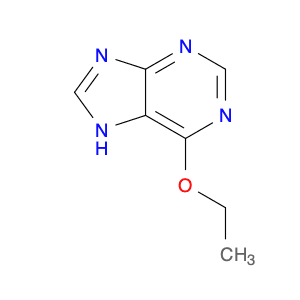
6-Ethoxy-1H-purine is a purine derivative characterized by the presence of an ethoxy group at the 6-position of the purine ring. This compound is typically a white to off-white solid, and it is soluble in polar organic solvents. Its molecular structure features a fused bicyclic system consisting of a pyrimidine and imidazole ring, which is characteristic of purines. The ethoxy substituent can influence the compound's biological activity and solubility, making it of interest in medicinal chemistry and pharmacology. 6-Ethoxy-1H-purine may exhibit various biological activities, including potential roles as a nucleoside analog or in modulating enzymatic pathways. Its CAS number, 17861-06-2, is a unique identifier that facilitates the search for information regarding its properties, synthesis, and applications in scientific literature. As with many purine derivatives, it may also be involved in research related to nucleic acids and cellular processes.
Formula:C7H8N4O
InChI:InChI=1S/C7H8N4O/c1-2-12-7-5-6(9-3-8-5)10-4-11-7/h3-4H,2H2,1H3,(H,8,9,10,11)
InChI key:InChIKey=BMLKPGJBYUTIHT-UHFFFAOYSA-N
SMILES:O(CC)C1=C2C(N=CN2)=NC=N1
Synonyms:- 1H-Purine, 6-ethoxy-
- 1H-Purine, 6-ethoxy- (9CI)
- 6-Ethoxy-9H-purine
- 6-Ethoxypurine
- 9H-Purine, 6-ethoxy-
- Nsc 19074
- Purine, 6-ethoxy-
- 6-Ethoxy-1H-purine
Sort by
Purity (%)
0
100
|
0
|
50
|
90
|
95
|
100
Found 4 products.
6-Ethoxypurine
CAS:6-Ethoxypurine is a nucleoside analog that inhibits the enzyme ribonucleotide reductase, which converts ribonucleotides to deoxyribonucleotides. It is used in cell culture to measure the effects of radiation and hydrochloric acid on the production of ATP. 6-Ethoxypurine has been shown to inhibit influenza virus replication with an IC50 of 10 μM. This compound has reactive hydroxyl groups that allow it to participate in hydrogen bonding, which can be beneficial for interactions with other molecules. 6-Ethoxypurine also exhibits nucleophilic properties, which allows it to react with other chemical species and can be useful for generating new chemical compounds.Formula:C7H8N4OPurity:Min. 95%Color and Shape:PowderMolecular weight:164.16 g/mol