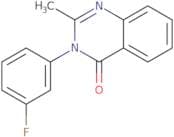
CAS 1789-04-4
:3-(3-fluorophenyl)-2-methylquinazolin-4(3H)-one
Description:
3-(3-Fluorophenyl)-2-methylquinazolin-4(3H)-one, with the CAS number 1789-04-4, is a chemical compound that belongs to the quinazolinone class of heterocyclic compounds. It features a quinazolinone core structure, which is characterized by a fused benzene and pyrimidine ring system. The presence of a 3-fluorophenyl group at one position and a methyl group at another position on the quinazolinone ring contributes to its unique chemical properties. This compound is typically a solid at room temperature and may exhibit moderate solubility in organic solvents. Its fluorine substituent can influence its electronic properties, potentially enhancing its reactivity and biological activity. Compounds of this type are often studied for their pharmacological properties, including potential applications in medicinal chemistry as they may exhibit anti-cancer, anti-inflammatory, or antimicrobial activities. As with many organic compounds, the specific characteristics such as melting point, boiling point, and spectral data would depend on the purity and specific conditions under which the compound is analyzed.
Formula:C15H11FN2O
InChI:InChI=1/C15H11FN2O/c1-10-17-14-8-3-2-7-13(14)15(19)18(10)12-6-4-5-11(16)9-12/h2-9H,1H3
SMILES:Cc1nc2ccccc2c(=O)n1c1cccc(c1)F
Sort by
Purity (%)
0
100
|
0
|
50
|
90
|
95
|
100
Found 1 products.
3-(3-Fluorophenyl)-2-Methylquinazolin-4(3H)-One
CAS:Controlled ProductQuinazolinones are a class of chemicals that inhibit the enzyme acetylcholinesterase. 3-Fluorophenyl-2-methylquinazolin-4(3H)-one (3FPMQ) is a connector molecule that has been shown to be an inhibitor of acetylcholinesterase, the enzyme responsible for the breakdown of the neurotransmitter acetylcholine. It is also an antenna molecule that can be used in ethyl esters and enzymatic assays. The high resistance of this molecule has been shown by chemical treatments and chemical analyses. Amplitudes generated by 3FPMQ have been shown to be effective at positioning it next to naphthalene, which is a ring structure with two c1-c6 alkoxy groups on either side. This molecule has also shown muscle relaxant properties.Formula:C15H11FN2OPurity:Min. 95%Molecular weight:254.26 g/mol