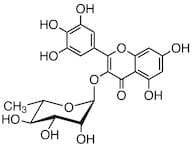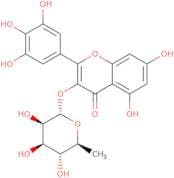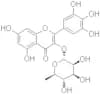
CAS 17912-87-7
:Myricitrin
Description:
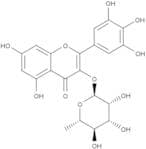
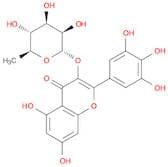
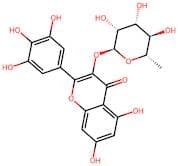
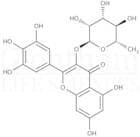
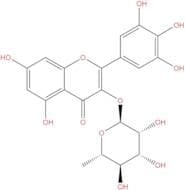
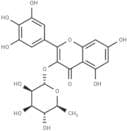
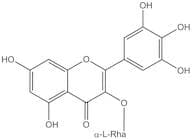
Myricitrin, with the CAS number 17912-87-7, is a flavonoid glycoside primarily found in various plants, particularly in the Myrica species. It is characterized by its structure, which consists of a myricetin aglycone linked to a rhamnose sugar moiety. Myricitrin exhibits several biological activities, including antioxidant, anti-inflammatory, and potential antimicrobial properties, making it of interest in pharmacological research. The compound is typically soluble in polar solvents, reflecting its glycosidic nature, and is often studied for its health benefits, particularly in traditional medicine. Additionally, myricitrin has been investigated for its role in protecting cells from oxidative stress and its potential to modulate various biochemical pathways. Its presence in dietary sources suggests that it may contribute to the health benefits associated with plant-based diets. Overall, myricitrin represents a significant compound in the field of natural products and phytochemistry, with ongoing research into its therapeutic applications.
Formula:C21H20O12
InChI:InChI=1/C21H20O12/c1-6-14(26)17(29)18(30)21(31-6)33-20-16(28)13-9(23)4-8(22)5-12(13)32-19(20)7-2-10(24)15(27)11(25)3-7/h2-6,14,17-18,21-27,29-30H,1H3
InChI key:InChIKey=DCYOADKBABEMIQ-OWMUPTOHSA-N
SMILES:O(C1=C(OC=2C(C1=O)=C(O)C=C(O)C2)C3=CC(O)=C(O)C(O)=C3)[C@H]4[C@H](O)[C@H](O)[C@@H](O)[C@H](C)O4
Synonyms:- 17912-87-7
- 3,3′,4′,5,5′,7-Hexahydroxyflavone, 3-rhamnoside
- 3-O-Rhamnosylmyricetin
- 3-[(6-Deoxy-α-<span class="text-smallcaps">L</span>-mannopyranosyl)oxy]-5,7-dihydroxy-2-(3,4,5-trihydroxyphenyl)-4H-1-benzopyran-4-one
- 4H-1-Benzopyran-4-one, 3-[(6-deoxy-α-<span class="text-smallcaps">L</span>-mannopyranosyl)oxy]-5,7-dihydroxy-2-(3,4,5-trihydroxyphenyl)-
- 4H-1-benzopyran-4-one, 3-[(6-deoxy-alpha-L-mannopyranosyl)oxy]-5,7-dihydroxy-2-(3,4,5-trihydroxyphenyl)-
- 5,7-Dihydroxy-3-{[(2S,3R,4R,5R,6S)-3,4,5-trihydroxy-6-methyltetrahydro-2H-pyran-2-yl]oxy}-2-(3,4,5-trihydroxyphenyl)-4H-chromen-4-on
- 5,7-Dihydroxy-3-{[(2S,3R,4R,5R,6S)-3,4,5-trihydroxy-6-methyltetrahydro-2H-pyran-2-yl]oxy}-2-(3,4,5-trihydroxyphenyl)-4H-chromen-4-one
- 5,7-Dihydroxy-4-oxo-2-(3,4,5-trihydroxyphenyl)-4H-chromen-3-yl 6-deoxy-a-L-mannopyranoside
- 5,7-Dihydroxy-4-oxo-2-(3,4,5-trihydroxyphenyl)-4H-chromen-3-yl 6-deoxy-alpha-L-mannopyranoside
- 5,7-dihydroxy-4-oxo-2-(3,4,5-trihydroxyphenyl)-4H-chromen-3-yl 6-deoxyhexopyranoside
- 6-Désoxy-alpha-L-mannopyranoside de 5,7-dihydroxy-4-oxo-2-(3,4,5-trihydroxyphényl)-4H-chromén-3-yle
- Myricetin 3-O-rhamnopyranoside
- Myricetin 3-O-rhamnoside
- Myricetin 3-O-α-<span class="text-smallcaps">L</span>-rhamnopyranoside
- Myricetin 3-O-α-<span class="text-smallcaps">L</span>-rhamnoside
- Myricetin 3-O-α-<span class="text-smallcaps">L</span>-rhamnpyronoside
- Myricetin 3-O-α-rhamnopyranoside
- Myricetin 3-rhamnoside
- Myricetin-3-O-α-rhamnoside
- Myricetin-3-O-β-rhamnopyranoside
- Myricitrin
- Myricitrine
- Myricitroside
- NSC 19803
- 4H-1-Benzopyran-4-one, 3-[(6-deoxy-α-L-mannopyranosyl)oxy]-5,7-dihydroxy-2-(3,4,5-trihydroxyphenyl)-
- 3-[(6-Deoxy-α-L-mannopyranosyl)oxy]-5,7-dihydroxy-2-(3,4,5-trihydroxyphenyl)-4H-1-benzopyran-4-one
- MYRICITRIN WITH HPLC
- MIRICITRIN
- 3-[(6-Deoxy-alpha-L-Mannopyranosyloxy)]-5,7-dihydroxy-2-(3,4,5-trihydroxyphenyl)-4H-chroMen-4-one
- CANNABISCITRIN
- 3,3′,4′,5,5′,7-Hexahydroxyflavone 3-O-rhamnoside
- Myricetin 3-O-α-L-rhamnopyranoside
- mannopyranosyl)oxy]-5,7-dihydroxy-2-(3,4,5-trihydroxyphenyl)-
- MYRICITRIN HPLC 98+%
- YRICITRIN
- Myricitrin(Myricitrine)
- MYRICITRIN(MYRICETIN-3-O-RHAMNOSIDE)(SH)
- 5,7-dihydroxy-3-((2s,3r,4r,5r,6s)-3,4,5-trihydroxy-6-methyl-tetrahydro-pyran-2-yloxy)-2-(3,4,5-trihydroxy-phenyl)-1-benzopyran-4-one
- 3-[(6-deoxy-alpha-L-mannopyranosyl)oxy]-5,7-dihydroxy-2-(3,4,5-trihydroxyphenyl)-4H-benzopyran-4-one
- Myricitrin, froM Myrica rubra
- Myricetin 3-α-L-rhamnopyranoside
- MYRICETIN-3-O-RHAVINOSIDE
- 5,7-Dihydroxy-3-((2S,3R,4R,5R,6S)-3,4,5-trihydroxy-6-methyl-tetrahydro-pyran-2-yloxy)-2-(3,4,5-trihydroxy-phenyl)-1-benzopyran-4-one
- 3',4',5,5',7-Pentahydroxy-3-(α-L-rhamnopyranosyloxy)flavone
- 4H-1-Benzopyran-4-one,3-[(6-deoxy-α-L-
- 3-[(6-deoxy-α-L-mannopyranosyl)oxy]-5,7-dihydroxy-2-(3,4,5-trihydroxyphenyl)-4H-benzopyran-4-one
- Myricetrin
- See more synonyms
Sort by
Purity (%)
0
100
|
0
|
50
|
90
|
95
|
100
Found 10 products.
Myricitrin
CAS:Formula:C21H20O12Purity:>98.0%(HPLC)Color and Shape:Light yellow to Yellow to Orange powder to crystalMolecular weight:464.38Myricitrin
CAS:Myricitrin analytical standard provided with w/w absolute assay, to be used for quantitative titration.Formula:C21H20O12Purity:(HPLC) ≥99%Color and Shape:PowderMolecular weight:464.38Myricitrin
CAS:Formula:C21H20O12Purity:(HPLC) ≥ 98.0%Color and Shape:White to light yellow powderMolecular weight:464.38Myricetrin
CAS:Myricitrin exhibits hepatoprotective, anti-inflammatory,antioxidant, anti-allergic, antinociception, anxiolytic-like, and antipsychotic-like effects. Myricitrin can be used as a drug candidate for the treatment of cardiovascular diseases, by effectively protecting cells from ox-LDL-induced endothelial cell apoptosis and reducing atherosclerotic plaque formation. Myricitrin is also a nitric oxide (NO) and protein kinase C (PKC) inhibitor that has central nervous system activity.Formula:C21H20O12Purity:95%~99%Molecular weight:464.379Myricitrin
CAS:Myricitrin (Myricitrine), a flavonoid compound isolated from the root bark of Myrica cerifera, exerts antinociceptive effects.Formula:C21H20O12Purity:99.72%Color and Shape:Light Yellow To Off-White Crystalline PowderMolecular weight:464.38Myricitrin
CAS:Natural glycosideFormula:C21H20O12Purity:≥ 95.0 % (HPLC)Color and Shape:PowderMolecular weight:464.38Myricitrin
CAS:Myricitrin is a natural compound that is found in the bark of the Myrica tree. It has been shown to have antioxidant effects and pro-apoptotic activities. Myricitrin has been shown to induce apoptosis in HL-60 cells through activation of the caspase-3 pathway, which includes cleavage of poly (ADP-ribose) polymerase and activation of caspases. In addition, myricitrin induces apoptosis by binding to DNA and inhibiting transcription. The physiological effects of myricetin are similar to those of myricitrin due to their structural similarity. However, there is no data available on the anti-inflammatory properties or hypoglycemic effect of myricetin.Formula:C21H20O12Purity:Min. 95%Color and Shape:White PowderMolecular weight:464.38 g/mol