CAS 17965-76-3
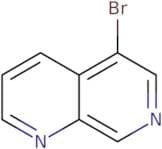
:5-Bromo-1,7-naphthyridine
Description:
5-Bromo-1,7-naphthyridine is a heterocyclic organic compound characterized by its bicyclic structure, which consists of a naphthyridine core with a bromine substituent at the 5-position. This compound features a nitrogen atom in the ring, contributing to its aromatic properties and influencing its reactivity. It is typically a pale yellow to off-white solid at room temperature and is soluble in organic solvents such as dimethyl sulfoxide (DMSO) and ethanol, but has limited solubility in water. The presence of the bromine atom enhances its electrophilic character, making it a useful intermediate in various chemical syntheses, particularly in the development of pharmaceuticals and agrochemicals. Additionally, 5-Bromo-1,7-naphthyridine can participate in various reactions, including nucleophilic substitutions and coupling reactions, due to the reactivity of the bromine atom. Its unique structure and properties make it a valuable compound in medicinal chemistry and materials science. Safety precautions should be taken when handling this compound, as with many halogenated organic substances.
Formula:C8H5BrN2
InChI:InChI=1S/C8H5BrN2/c9-7-4-10-5-8-6(7)2-1-3-11-8/h1-5H
InChI key:InChIKey=WNFILKMJRFZJBF-UHFFFAOYSA-N
SMILES:BrC=1C2=C(C=NC1)N=CC=C2
Synonyms:- 1,7-Naphthyridine, 5-bromo-
- 5-Bromo-1,7-naphthyridine
Sort by
Purity (%)
0
100
|
0
|
50
|
90
|
95
|
100
Found 4 products.
1,7-Naphthyridine, 5-bromo-
CAS:Formula:C8H5BrN2Purity:96%Color and Shape:SolidMolecular weight:209.04275-bromo-1,7-naphthyridine
CAS:5-bromo-1,7-naphthyridine is a heterocyclic compound that can be derived from pyrrole by the introduction of an electron deficiency. This molecule has been shown to react with nucleophiles such as water and amide in order to yield unsaturated products. The molecule also has electron-donating groups on it, which can be used to optimize yields. 5-bromo-1,7-naphthyridine is often used as a reagent in organic synthesis.
Formula:C8H5BrN2Purity:Min. 95%Molecular weight:209 g/mol

![5-Bromo-[1,7]naphthyridine](/_next/image/?url=https%3A%2Fstatic.cymitquimica.com%2Fproducts%2F54%2Fthumb%2FOR73110.jpg&w=3840&q=75)