CAS 1810-67-9
:6-CHLORO-2-HYDROXYQUINOLINE
Description:
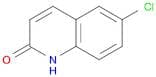
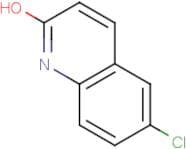
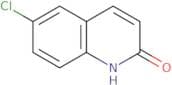
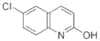
6-Chloro-2-hydroxyquinoline is an organic compound characterized by its quinoline structure, which consists of a fused benzene and pyridine ring. The presence of a chlorine atom at the 6-position and a hydroxyl group at the 2-position contributes to its unique chemical properties. This compound typically appears as a solid and is known for its potential applications in pharmaceuticals, particularly as an intermediate in the synthesis of various bioactive molecules. It exhibits moderate solubility in organic solvents and can participate in various chemical reactions, including nucleophilic substitutions and electrophilic aromatic substitutions, due to the electron-withdrawing nature of the chlorine atom and the electron-donating capacity of the hydroxyl group. Additionally, 6-chloro-2-hydroxyquinoline may exhibit biological activity, making it of interest in medicinal chemistry. Safety data should be consulted for handling and exposure guidelines, as with any chemical substance.
Formula:C9H6ClNO
Synonyms:- 6-Chloro-2(1H)-Quinolone
- 6-Chloro Carbostyril
- 6-Chloroquinolin-2(1H)-One
Sort by
Purity (%)
0
100
|
0
|
50
|
90
|
95
|
100
Found 4 products.
2(1H)-Quinolinone, 6-chloro-
CAS:Formula:C9H6ClNOPurity:98%Color and Shape:SolidMolecular weight:179.60306-Chloro-2-hydroxyquinoline
CAS:6-Chloro-2-hydroxyquinoline (6CHQ) is a quinoline derivative with an unusual structure. It has been shown to have a wide range of properties; for example, it is a metastable compound that can be synthesized in the solid state and its crystal structure has been determined at high resolution. 6CHQ exhibits strong anion binding and it is soluble in water. It undergoes red shift of its spectral bands when exposed to ultraviolet light and phosphorescence when heated. 6CHQ has also been studied by spectroscopic methods and found to exhibit strong interactions between the quinoline ring and the amino groups. 6CHQ has been shown to be spin-forbidden, meaning that it cannot exist in an excited state due to lack of a spin quantum number.
Purity:Min. 95%