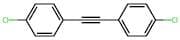
CAS 1820-42-4
:1,1'-ethyne-1,2-diylbis(4-chlorobenzene)
Description:
1,1'-Ethyne-1,2-diylbis(4-chlorobenzene), with the CAS number 1820-42-4, is an organic compound characterized by its structure, which features a central ethyne (acetylene) unit connected to two 4-chlorobenzene groups. This compound exhibits properties typical of aromatic compounds, including stability due to resonance and a relatively high melting and boiling point compared to non-aromatic hydrocarbons. The presence of chlorine substituents on the benzene rings enhances the compound's reactivity, particularly in electrophilic aromatic substitution reactions. Additionally, the ethyne linkage introduces a degree of unsaturation, which can participate in various chemical reactions, such as polymerization or cross-coupling reactions. The compound is likely to be insoluble in water but soluble in organic solvents, reflecting the hydrophobic nature of the aromatic rings. Its applications may include use in materials science, organic synthesis, or as an intermediate in the production of more complex chemical entities. Safety data should be consulted for handling and storage, as halogenated compounds can pose environmental and health risks.
Formula:C14H8Cl2
InChI:InChI=1/C14H8Cl2/c15-13-7-3-11(4-8-13)1-2-12-5-9-14(16)10-6-12/h3-10H
SMILES:C(#Cc1ccc(cc1)Cl)c1ccc(cc1)Cl
Synonyms:- 1-Chloro-4-[(4-chlorophenyl)ethynyl]benzene
- Bis[p-chlorophenyl]acetylene
Sort by
Purity (%)
0
100
|
0
|
50
|
90
|
95
|
100
Found 3 products.
1,2-Bis(4-chlorophenyl)ethyne
CAS:1,2-Bis(4-chlorophenyl)ethynePurity:99%Molecular weight:247.12g/mol4,4'-Dichlorodiphenylacetylene
CAS:4,4'-Dichlorodiphenylacetylene is a chiral molecule that is used as an organic catalyst. It can be used to synthesize aldehydes and azides, which are important in the production of pharmaceuticals, agrochemicals, and dyestuffs. This molecule has shown to be useful for the catalytic conversion of a variety of chlorinated aromatic compounds to their corresponding chloroformates. 4,4'-Dichlorodiphenylacetylene is also good at accommodating bulky molecules by using its bifunctional nature. The mechanism of this reaction has been studied in detail and it has been found that this process takes place through a combination of thermal and mechanistic reactions with quantum theory.Formula:C14H8Cl2Purity:Min. 98 Area-%Color and Shape:PowderMolecular weight:247.12 g/mol