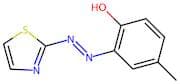
CAS 1823-44-5
:2-(2-Thiazolylazo)-p-cresol
Description:
2-(2-Thiazolylazo)-p-cresol, commonly referred to as TACP, is an organic compound characterized by its azo and thiazole functional groups. It is typically used as a chelating agent and a colorimetric reagent in analytical chemistry, particularly for the detection of metal ions. The compound exhibits a strong affinity for various transition metals, forming stable complexes that can be detected visually due to their distinct colors. TACP is known for its solubility in organic solvents and moderate solubility in water, which makes it versatile for different applications. Its molecular structure includes a thiazole ring, which contributes to its reactivity and coordination properties. Additionally, TACP is sensitive to pH changes, which can affect its colorimetric response, making it useful in titrations and other analytical methods. Safety precautions should be taken when handling this compound, as it may pose health risks if ingested or inhaled. Overall, TACP is a valuable tool in chemical analysis and research, particularly in the field of coordination chemistry.
Formula:C10H9N3OS
InChI:InChI=1S/C10H9N3OS/c1-7-2-3-9(14)8(6-7)12-13-10-11-4-5-15-10/h2-6,14H,1H3
InChI key:InChIKey=MZRKINSTWYZJLV-UHFFFAOYSA-N
SMILES:N(=NC1=NC=CS1)C2=C(O)C=CC(C)=C2
Synonyms:- (6E)-4-methyl-6-[2-(1,3-thiazol-2-yl)hydrazinylidene]cyclohexa-2,4-dien-1-one
- 2-(2-Thiazolylazo)-4-methylphenol
- 4-Me-TAP
- 4-Methyl-2-(2-thiazolylazo)-phenol
- 4-Methyl-2-[2-(2-thiazolyl)diazenyl]phenol
- 4-Methyl-6-(1,3-Thiazol-2-Ylhydrazono)Cyclohexa-2,4-Dien-1-One
- Phenol, 4-methyl-2-(2-thiazolylazo)-
- Phenol, 4-methyl-2-[2-(2-thiazolyl)diazenyl]-
- TAC
- o-(2-Thiazolylazo)-4-methylphenol
- p-Cresol, 2-(2-thiazolylazo)-
Sort by
Purity (%)
0
100
|
0
|
50
|
90
|
95
|
100
Found 3 products.
Phenol, 4-methyl-2-[2-(2-thiazolyl)diazenyl]-
CAS:Formula:C10H9N3OSPurity:98%Color and Shape:SolidMolecular weight:219.26302-(2-Thiazolylazo)-p-cresol
CAS:2-(2-Thiazolylazo)-p-cresol structure enables it to form complexes with certain metal ions, changing color in the process. This color change is highly useful in titrimetric analyses (quantitative chemical analysis method) to determine the concentration of metal ions in a solution. The substrates are colored orange-yellow (absorbance maximum= 375 nm). After the enzymatic conversion, the resulting TAC shows an intense, soluble red-violet color (544 nm) in an alkaline medium (pH = 10.3).Formula:C10H9N3OSPurity:Min. 96 Area-%Color and Shape:Yellow To Orange Brown SolidMolecular weight:219.26 g/mol
![Phenol, 4-methyl-2-[2-(2-thiazolyl)diazenyl]-](/_next/image/?url=https%3A%2Fstatic.cymitquimica.com%2Fproducts%2FIN%2Fthumb%2FDA0023LJ.jpg&w=3840&q=75)