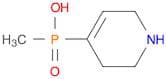
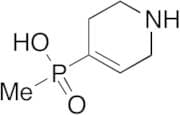
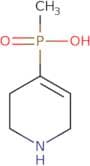
CAS 182485-36-5
:P-Methyl-P-(1,2,3,6-tetrahydro-4-pyridinyl)phosphinic acid
Description:
P-Methyl-P-(1,2,3,6-tetrahydro-4-pyridinyl)phosphinic acid, identified by its CAS number 182485-36-5, is a chemical compound that features a phosphinic acid functional group. This substance is characterized by the presence of a methyl group and a tetrahydro-pyridine moiety, which contributes to its unique chemical properties. The phosphinic acid group typically exhibits moderate acidity and can participate in various chemical reactions, including nucleophilic substitutions and coordination with metal ions. The tetrahydro-pyridine structure may influence the compound's biological activity, potentially affecting its interactions with biological systems. This compound is of interest in medicinal chemistry and may have applications in drug development or as a biochemical tool. Its solubility, stability, and reactivity can vary based on environmental conditions such as pH and temperature. As with many phosphinic acids, safety precautions should be observed when handling this compound, as it may exhibit toxicity or environmental hazards.
Formula:C6H12NO2P
InChI:InChI=1S/C6H12NO2P/c1-10(8,9)6-2-4-7-5-3-6/h2,7H,3-5H2,1H3,(H,8,9)
InChI key:InChIKey=MFUKVPOVVKKLRQ-UHFFFAOYSA-N
SMILES:P(C)(=O)(O)C=1CCNCC1
Synonyms:- (1,2,5,6-Tetrahydropyridin-4-Yl)Methylphosphinic Acid Hydrate
- P-Methyl-P-(1,2,3,6-tetrahydro-4-pyridinyl)phosphinic acid
- Phosphinic acid, P-methyl-P-(1,2,3,6-tetrahydro-4-pyridinyl)-
- Phosphinic acid, methyl(1,2,3,6-tetrahydro-4-pyridinyl)-
- Tpmpa
- Tpmpa Hydrate
Sort by
Purity (%)
0
100
|
0
|
50
|
90
|
95
|
100
Found 4 products.
Phosphinic acid, P-methyl-P-(1,2,3,6-tetrahydro-4-pyridinyl)-
CAS:Formula:C6H12NO2PPurity:98%Color and Shape:SolidMolecular weight:161.1387TPMPA
CAS:TPMPA is a gamma-aminobutyric acid (GABA) receptor antagonist that binds to the GABA receptor and blocks its activity. It also has been shown to have synergistic effects with other GABAergic agents, including benzodiazepines, barbiturates, and neurosteroids. TPMPA is able to inhibit the production of pro-apoptotic proteins by binding to the GABAA receptor in cells. The binding site of TPMPA on the GABAA receptor is located at the α1 subunit and it can bind competitively with agonist molecules. TPMPA can be used as a pharmacological agent for treatment of neurological disorders such as epilepsy and Alzheimer's disease because it inhibits glutamate release from neurons and prevents calcium from entering cells.Formula:C6H12NO2PPurity:Min. 95%Molecular weight:161.14 g/mol