CAS 182949-89-9
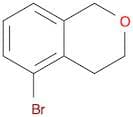
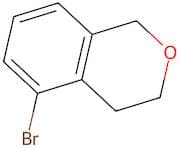
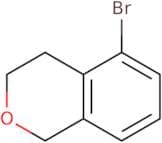
:5-Bromo-3,4-dihydro-1H-2-benzopyran
Description:
5-Bromo-3,4-dihydro-1H-2-benzopyran is a chemical compound characterized by its bicyclic structure, which includes a benzene ring fused to a pyran ring. The presence of a bromine atom at the 5-position contributes to its reactivity and potential applications in organic synthesis. This compound typically exhibits properties associated with both aromatic and aliphatic systems, such as moderate solubility in organic solvents and potential for electrophilic substitution reactions due to the bromine substituent. The dihydro configuration indicates that the compound has two hydrogen atoms added to the pyran ring, which can influence its stability and reactivity. It may also exhibit biological activity, making it of interest in medicinal chemistry. The compound's molecular structure allows for various functional group transformations, which can be exploited in synthetic pathways. Overall, 5-Bromo-3,4-dihydro-1H-2-benzopyran is a versatile compound with applications in research and development within the fields of organic chemistry and pharmaceuticals.
Formula:C9H9BrO
InChI:InChI=1S/C9H9BrO/c10-9-3-1-2-7-6-11-5-4-8(7)9/h1-3H,4-6H2
InChI key:InChIKey=HDHXNQYPFLNOOP-UHFFFAOYSA-N
SMILES:BrC1=C2C(=CC=C1)COCC2
Synonyms:- 5-Bromo-3,4-dihydro-1H-2-benzopyran
- 1H-2-Benzopyran, 5-bromo-3,4-dihydro-
Sort by
Purity (%)
0
100
|
0
|
50
|
90
|
95
|
100
Found 4 products.
5-Bromo-3,4-dihydro-1H-2-benzopyran
CAS:5-Bromo-3,4-dihydro-1H-2-benzopyran is an organic solvent that is used to introduce bromine into organic compounds. It can be synthesized by reacting benzene with n-hexane in the presence of a catalyst, such as palladium on carbon. This reaction results in the formation of 5-bromo-3,4-dihydrobenzoquinone through an aerobic oxidation reaction. The yield from this reaction can be increased by using aerobic conditions. The mechanism for this reaction is similar to that of other organic reactions involving benzene and hexane.Formula:C9H9BrOPurity:Min. 95%Molecular weight:213.07 g/mol