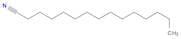
CAS 18300-91-9
:Pentadecanenitrile
Description:
Pentadecanenitrile, with the CAS number 18300-91-9, is a long-chain aliphatic nitrile characterized by a straight-chain structure consisting of 15 carbon atoms and a cyano group (-C≡N) at one end. This compound is a colorless to pale yellow liquid at room temperature and is insoluble in water due to its hydrophobic nature, but it is soluble in organic solvents such as ethanol and ether. Pentadecanenitrile exhibits a relatively high boiling point and melting point compared to shorter-chain nitriles, reflecting its larger molecular size. It is primarily used in organic synthesis and as an intermediate in the production of various chemicals, including pharmaceuticals and agrochemicals. Additionally, pentadecanenitrile can serve as a lubricant and a plasticizer in certain applications. Its chemical stability and low reactivity make it suitable for various industrial processes, although care should be taken due to potential toxicity associated with nitriles. Overall, pentadecanenitrile is a significant compound in both research and industrial contexts.
Formula:C15H29N
InChI:InChI=1S/C15H29N/c1-2-3-4-5-6-7-8-9-10-11-12-13-14-15-16/h2-14H2,1H3
InChI key:InChIKey=KRKQHNVYOWTEQO-UHFFFAOYSA-N
SMILES:C(CCCCCCC#N)CCCCCCC
Synonyms:- 1-Tetradecyl cyanide
- 2-Methylpyridin-4-Amine
- Pentadecanenitrile
- Pentadecanonitrile
- Tetradecyl cyanide
Sort by
Purity (%)
0
100
|
0
|
50
|
90
|
95
|
100
Found 4 products.
Pentadecanonitrile
CAS:Formula:C15H29NPurity:>98.0%(GC)Color and Shape:White or Colorless to Light yellow powder to lump to clear liquidMolecular weight:223.40Pentadecanonitrile
CAS:Pentadecanonitrile is an organic compound that is a coenzyme Q10 analog. It has been shown to be a homogeneous catalyst for the production of citric acid, which is used in the food and pharmaceutical industries. Pentadeaconitrile is also used as a chemical intermediate for the synthesis of other compounds. The stability of this compound under acidic conditions makes it suitable for use in medicines and nutritional supplements. A typical reaction using pentadeaconitrile produces alkanoic acid with a nonpolar solvent such as hexane or heptane, which can then be purified by distillation. Pentadeaconitrile is typically produced from hydrochloric acid and fatty acids, such as oleic acid or linoleic acid, through the Fischer-Tropsch process.Formula:C15H29NPurity:Min. 95%Molecular weight:223.4 g/mol