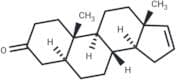
CAS 18339-16-7
:Androstenone
Description:
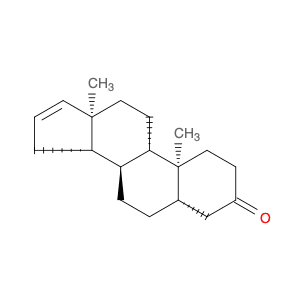
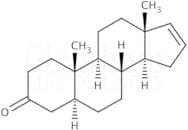
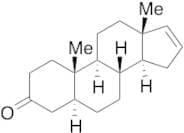
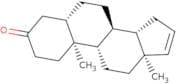
Androstenone, with the CAS number 18339-16-7, is a steroidal pheromone and a member of the androstane family. It is a colorless to pale yellow crystalline solid that is insoluble in water but soluble in organic solvents. Androstenone is primarily known for its role in the olfactory signaling of mammals, influencing social and sexual behaviors. It has a characteristic musky odor, which can vary in perception among individuals, with some finding it pleasant and others perceiving it as unpleasant. The compound is produced in the adrenal glands and gonads of both males and females, although it is more prevalent in males. Androstenone is often studied in the context of human attraction and pheromonal communication, with research suggesting it may play a role in mate selection. Additionally, it has applications in the fragrance industry, where it is used as a scent component in perfumes and colognes. Its chemical structure includes a ketone functional group, contributing to its reactivity and interactions with olfactory receptors.
Formula:C19H28O
InChI:InChI=1S/C19H28O/c1-18-9-3-4-16(18)15-6-5-13-12-14(20)7-11-19(13,2)17(15)8-10-18/h3,9,13,15-17H,4-8,10-12H2,1-2H3/t13-,15-,16-,17-,18-,19-/m0/s1
InChI key:InChIKey=HFVMLYAGWXSTQI-QYXZOKGRSA-N
SMILES:C[C@@]12[C@@]3([C@]([C@]4([C@](C)(CC3)C=CC4)[H])(CC[C@]1(CC(=O)CC2)[H])[H])[H]
Synonyms:- (5Alpha,14Beta)-Androst-16-En-3-One
- (5Alpha,9Beta)-Androst-16-En-3-One
- (5Alpha,9Beta,14Beta)-Androst-16-En-3-One
- 16,(5α)-Androsten-3-one
- 5Alpha-Androst-16-En-3-One
- 5α-Androst-16-ene-3-one
- 5α-Androstenone
- Androst-16-en-3-one, (5α)-
- Androstenone
- E 282
- 5α-Androst-16-en-3-one
- See more synonyms
Sort by
Purity (%)
0
100
|
0
|
50
|
90
|
95
|
100
Found 7 products.
Androst-16-en-3-one, (5α)-
CAS:Formula:C19H28OPurity:98%Color and Shape:SolidMolecular weight:272.42505α-Androst-16-en-3-one
CAS:Formula:C19H28OPurity:(NMR) ≥ 98.0%Color and Shape:White powderMolecular weight:272.4316-(5α)-Androsten-3-one-2,2,4,4-d4
CAS:Purity:98 atom % DColor and Shape:White SolidMolecular weight:276.455alpha-Androstenone-d4
CAS:Controlled ProductApplications 5α-Androstenone-d4 is the isotope labelled analog of 5α-Androstenone (A637775); a volatile steroid found in human perspiration, boar saliva, truffles, and celery. It was also identified as the first mammalian pheromone.
References Wysocki, C.J., et al.: P. Natl. Acad. Sci. USA, 86, 7976 (1989); Dorries, K.M., et al.: Brain Behav. Evol., 49, 53 (1997)Formula:C19D4H24OColor and Shape:NeatMolecular weight:276.455α-Androstenone
CAS:Applications 5α-Androstenone is a volatile steroid found in human perspiration, boar saliva, truffles, and celery. It was also identified as the first mammalian pheromone.
References Wysocki, C.J., et al.: P. Natl. Acad. Sci. USA, 86, 7976 (1989); Dorries, K.M., et al.: Brain Behav. Evol., 49, 53 (1997)Formula:C19H28OColor and Shape:White To Off-WhiteMolecular weight:272.425a-Androst-16-en-3-one
CAS:Controlled Product5a-Androsten-3,16-dione is a steroid hormone that binds to the androgen receptor. It is present in sweat and urine and may be used as a marker for the detection of testosterone doping. Studies have shown that 5a-androsten-3,16-dione interacts with other hormones such as estradiol benzoate and skatole. The transfection experiments showed significant interactions between 5a-androsten-3,16-dione and pueraia lobata extract. The sample preparation methods should include extraction with organic solvents such as ethyl acetate or chloroform/methanol followed by liquid–liquid partitioning with water or ethyl acetate to remove any lipids. The analytical method used in this study was gas chromatography/mass spectrometry (GC/MS). GC/MS analysis demonstrated that 5a-androsten-3,16-dione can be detected inFormula:C19H28OPurity:Min. 98 Area-%Color and Shape:PowderMolecular weight:272.43 g/mol5α-Androst-16-en-3-one
CAS:5α-Androst-16-en-3-one, a mammalian pheromone present in boar saliva, plays a crucial role in facilitating social and sexual interactions by acting as a volatile chemical cue. It is utilized to prime sows in estrus for mating or artificial insemination, underscoring its significance in reproductive behavior. Additionally, this compound is detected in human sweat and urine, where it is involved in studies concerning receptor-mediated odorant detection and the genetic foundations of anosmias, thereby broadening its scope of relevance beyond the animal kingdom.Formula:C19H28OColor and Shape:SolidMolecular weight:272.432