CAS 18386-03-3
:3-(3-BROMO-PHENOXY)-PROPIONIC ACID
Description:
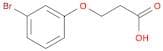
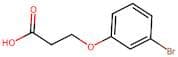
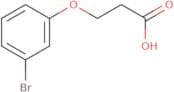
3-(3-Bromo-phenoxy)-propionic acid is an organic compound characterized by its structure, which includes a propionic acid moiety linked to a phenoxy group that is further substituted with a bromine atom at the meta position. This compound typically appears as a white to off-white solid and is soluble in organic solvents, with limited solubility in water due to its hydrophobic phenyl group. The presence of the bromine atom enhances its reactivity, making it useful in various chemical syntheses and applications, particularly in pharmaceuticals and agrochemicals. The carboxylic acid functional group contributes to its acidity and potential for forming salts or esters. Additionally, the compound may exhibit biological activity, which can be explored in medicinal chemistry contexts. Safety data should be consulted for handling and storage, as halogenated compounds can pose environmental and health risks. Overall, 3-(3-bromo-phenoxy)-propionic acid is a versatile compound with significant implications in chemical research and development.
Formula:C9H9BrO3
InChI:InChI=1/C9H9BrO3/c10-7-2-1-3-8(6-7)13-5-4-9(11)12/h1-3,6H,4-5H2,(H,11,12)
SMILES:c1cc(cc(c1)OCCC(=O)O)Br
Synonyms:- 3-(3-Bromophenoxy)Propanoate
- 3-(3-Bromophenoxy)Propanoic Acid
Sort by
Purity (%)
0
100
|
0
|
50
|
90
|
95
|
100
Found 4 products.
3-(3-Bromophenoxy)propanoic acid
CAS:3-(3-Bromophenoxy)propanoic acidPurity:98%Molecular weight:245.07g/mol3-(3-bromophenoxy)propanoic acid
CAS:3-(3-Bromophenoxy)propanoic acid is a synthetic chemical compound that inhibits the growth of bacteria. It has been shown to have antibacterial activity against Staphylococcus aureus, Proteus mirabilis, and Pseudomonas aeruginosa. 3-(3-Bromophenoxy)propanoic acid inhibits bacterial synthesis of DNA by reacting with the nucleophilic center of the enzyme thiosemicarbazide (TSC). This reaction disrupts the DNA chain, preventing it from being replicated. 3-(3-Bromophenoxy)propanoic acid also prevents bacterial cell division by inhibiting protein synthesis. Further study on this chemical will be necessary to determine its mechanism of action.
Formula:C9H9BrO3Purity:Min. 95%Molecular weight:245.07 g/mol