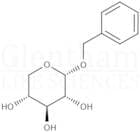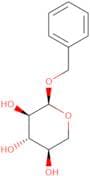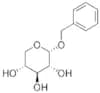
CAS 18403-12-8
:Benzyl-a-D-xylopyranoside
Description:
Benzyl-α-D-xylopyranoside is a glycoside derived from the sugar xylopyranose, where a benzyl group is attached to the anomeric carbon of the sugar. This compound typically appears as a white to off-white crystalline solid and is soluble in organic solvents such as methanol and ethanol, but has limited solubility in water due to its hydrophobic benzyl group. It is often used in biochemical research and synthesis, particularly in studies involving carbohydrate chemistry and glycosylation reactions. The presence of the benzyl group enhances its stability and can influence its reactivity, making it a useful intermediate in the synthesis of more complex carbohydrates or glycosides. Additionally, Benzyl-α-D-xylopyranoside may exhibit biological activities, although specific interactions and effects can vary depending on the context of its use. As with many glycosides, it is important to handle this compound with care, following appropriate safety protocols in laboratory settings.
Formula:C12H16O5
InChI:InChI=1/C12H16O5/c13-9-7-17-12(11(15)10(9)14)16-6-8-4-2-1-3-5-8/h1-5,9-15H,6-7H2
SMILES:c1ccc(cc1)COC1C(C(C(CO1)O)O)O
Synonyms:- Benzyl Pentopyranoside
Sort by
Purity (%)
0
100
|
0
|
50
|
90
|
95
|
100
Found 2 products.
Benzyl a-D-xylopyranoside
CAS:Benzyl a-D-xylopyranoside is a benzyl galactofuranose that is synthesized from the condensation of benzaldehyde and D-xylose. This compound has been shown to be an excellent target molecule for the detection of Mycobacterium tuberculosis, as it constitutes about 10% of the mycolic acid in this organism. Benzyl a-D-xylopyranoside can also be used to detect other bacteria such as Actinomyces, Streptomyces, and Corynebacterium. The yield of this compound is high and its regiospecificity is complete.
Formula:C12H16O5Purity:Min. 95%Color and Shape:PowderMolecular weight:240.25 g/mol