CAS 184576-63-4
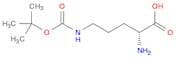
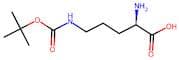
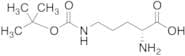
:H-D-Orn(Boc)-OH
Description:
H-D-Orn(Boc)-OH, also known as Nα-Boc-D-ornithine, is a protected form of the amino acid ornithine, which is a non-proteinogenic amino acid involved in the urea cycle. The "Boc" (tert-butyloxycarbonyl) group serves as a protective group for the amino group, allowing for selective reactions without interfering with the amino functionality. This compound is typically used in peptide synthesis, where the protection of functional groups is crucial for controlling the reaction pathways. H-D-Orn(Boc)-OH is characterized by its ability to form peptide bonds, making it valuable in the development of peptides and other bioactive compounds. It is generally soluble in organic solvents and has a specific reactivity profile due to the presence of both the Boc group and the carboxylic acid functionality. The compound is often utilized in research and pharmaceutical applications, particularly in the synthesis of cyclic peptides and other complex structures. Proper handling and storage conditions are essential to maintain its stability and reactivity.
Formula:C10H20N2O4
Synonyms:- D-Ornithine(Boc)-Oh
- N-Delta-T-Boc-D-Ornithine
- N-Delta-T-Butoxycarbonyl-D-Ornithine
- N-Delta-Boc-D-Ornithine
Sort by
Purity (%)
0
100
|
0
|
50
|
90
|
95
|
100
Found 4 products.
(R)-2-Amino-5-((tert-butoxycarbonyl)amino)pentanoic acid
CAS:Formula:C10H20N2O4Purity:95%Color and Shape:SolidMolecular weight:232.28N-δ-BOC-D-Ornithine
CAS:Controlled ProductApplications N-δ-BOC-D-Ornithine is derived from D-Ornithine Hydrochloride (O695545), which is the D-enatiomer and putative metabolite of the non-essential amino acid L-Orthinine. Stress response studies show intracerebroventricular D-Ornithine Hydrochloride weakly attenuated stress response in neonatal chick under acute stressful condition.
References Kurauchi, I. et al.: J. Animal Vet. Adv., 8, 2580 (2009);Formula:C10H20N2O4Color and Shape:NeatMolecular weight:232.277