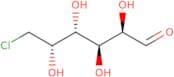
CAS 18465-32-2
:6-Chloro-6-deoxy-D-galactose
Description:
6-Chloro-6-deoxy-D-galactose is a monosaccharide derivative of galactose, characterized by the presence of a chlorine atom at the 6-position and the absence of a hydroxyl group at the same position, which distinguishes it from its parent compound. This modification alters its chemical reactivity and biological properties. The substance is typically a white to off-white crystalline solid, soluble in water due to its polar hydroxyl groups, except for the chlorinated position. It may exhibit specific optical activity, as it retains the chiral center present in galactose. The compound can participate in various chemical reactions, including glycosylation and substitution reactions, making it of interest in synthetic organic chemistry and potentially in the development of pharmaceuticals or glycosylated compounds. Its unique structure may also influence its interaction with biological systems, potentially affecting its role in metabolic pathways or as a substrate for enzymes. Safety data should be consulted for handling and usage, as with any chemical substance.
Formula:C6H11ClO5
InChI:InChI=1S/C6H11ClO5/c7-1-3(9)5(11)6(12)4(10)2-8/h2-6,9-12H,1H2/t3-,4+,5+,6-/m1/s1
InChI key:InChIKey=ZHVNVPHMOCWHHO-DPYQTVNSSA-N
SMILES:[C@@H]([C@@H]([C@H](C=O)O)O)([C@@H](CCl)O)O
Synonyms:- 6-Chloro-6-deoxy-<span class="text-smallcaps">D</span>-galactose
- 6-chloro-6-deoxy-D-galactose
- <span class="text-smallcaps">D</span>-Galactose, 6-chloro-6-deoxy-
- D-Galactose, 6-chloro-6-deoxy-
- Galactose, 6-chloro-6-deoxy-
- Galactose, 6-chloro-6-deoxy-, <span class="text-smallcaps">D</span>-
- Galactose, 6-chloro-6-deoxy-, D-
- 6-Chloro-6-deoxygalactose
Sort by
Purity (%)
0
100
|
0
|
50
|
90
|
95
|
100
Found 1 products.
6-Chloro-6-deoxy-D-galactose
CAS:6-Chloro-6-deoxy-D-galactose is a sugar that is found in the cell wall of Mycobacterium tuberculosis. This sugar is transported by chloride anions and has been shown to be essential for bacterial growth. 6-Chloro-6-deoxy-D-galactose has also been shown to inhibit the transport of dlucose into cells, which may contribute to its inhibitory effect on glucose transport. The process by which this sugar is transported across the membrane is still not fully understood, but it has been shown to involve hydrogen bonds and ionic interactions.Formula:C6H11ClO5Purity:Min. 95%Molecular weight:198.6 g/mol