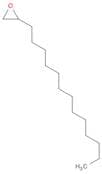
CAS 18633-25-5
:2-Tridecyloxirane
Description:
2-Tridecyloxirane, with the CAS number 18633-25-5, is an organic compound characterized by its epoxide functional group, which is a three-membered cyclic ether. This compound features a tridecyl chain, indicating that it has a long hydrocarbon tail, contributing to its hydrophobic properties. The presence of the epoxide group imparts unique reactivity, making it a useful intermediate in organic synthesis, particularly in the production of various polymers and fine chemicals. 2-Tridecyloxirane is typically a colorless liquid at room temperature and may exhibit a mild odor. Its chemical stability is influenced by the presence of the epoxide, which can undergo ring-opening reactions in the presence of nucleophiles. Additionally, the long alkyl chain enhances its solubility in non-polar solvents while limiting its miscibility with water. Safety considerations are important when handling this compound, as epoxides can be irritants and may pose health risks if not managed properly. Overall, 2-Tridecyloxirane is a versatile compound with applications in various chemical processes.
Formula:C15H30O
InChI:InChI=1S/C15H30O/c1-2-3-4-5-6-7-8-9-10-11-12-13-15-14-16-15/h15H,2-14H2,1H3
InChI key:InChIKey=QMIBIXKZPBEGTE-UHFFFAOYSA-N
SMILES:C(CCCCCCCCCCCC)C1CO1
Synonyms:- Oxirane, 2-tridecyl-
- 1-Pentadecene oxide
- Oxirane, tridecyl-
- 2-Tridecyloxirane
- Pentadecane, 1,2-epoxy-
Sort by
Purity (%)
0
100
|
0
|
50
|
90
|
95
|
100
Found 4 products.
2-Tridecyloxirane
CAS:2-Tridecyloxirane is a diagnostic agent that is used to identify hydroxy groups in collagen. It reacts with the hydroxyl group on collagen, forming an acyl chloride intermediate. This intermediate can be detected using a gas chromatography technique. The biodegradability of 2-tridecyloxirane has been studied and found to be dependent on the environment in which it is released. It was found to have a half-life of around 4 days in water, but up to 8 months in soil. The viscosity of 2-tridecyloxirane has been shown to decrease as the temperature increases, with the highest rate of change at temperatures above 150°C. This chemical has also been shown to react with primary amines and alicyclic compounds, such as ebola virus.
Formula:C15H30OPurity:Min. 95%Molecular weight:226.4 g/mol