CAS 18643-08-8
:Octadecyldimethylchlorosilane
Description:
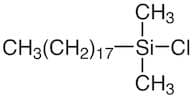
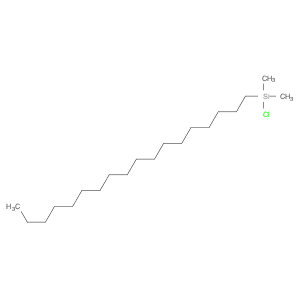
Octadecyldimethylchlorosilane, with the CAS number 18643-08-8, is an organosilicon compound characterized by its long hydrophobic alkyl chain and a chlorosilane functional group. This compound typically appears as a colorless to pale yellow liquid and is known for its ability to form self-assembled monolayers on various substrates, making it valuable in surface modification applications. Its hydrophobic nature is attributed to the octadecyl (C18) chain, which enhances water repellency and reduces surface energy. Octadecyldimethylchlorosilane is often utilized in the production of hydrophobic coatings, as well as in the preparation of functionalized silica and other materials for use in electronics, biotechnology, and materials science. Additionally, it can react with moisture to form siloxane bonds, leading to the formation of stable silane networks. Safety precautions are necessary when handling this compound, as it can be irritating to the skin and eyes, and proper storage conditions should be maintained to prevent hydrolysis.
Formula:C20H43ClSi
InChI:InChI=1S/C20H43ClSi/c1-4-5-6-7-8-9-10-11-12-13-14-15-16-17-18-19-20-22(2,3)21/h4-20H2,1-3H3
InChI key:InChIKey=GZGREZWGCWVAEE-UHFFFAOYSA-N
SMILES:C(CCCCCCCCCCCCCCC)CC[Si](C)(C)Cl
Synonyms:- Chlorooctadecyldimethylsilane
- Dimethyl(octadecyl)chlorosilane
- Dimethyl(octadecyl)silyl chloride
- Dimethyl(octyldecyl)silyl chloride
- N-octadecyldimethylchlorosilane
- Octadecylchlorodimethylsilane
- Octadecyldimethylchlorosilane
- Silane, chlorodimethyloctadecyl-
- Chlorodimethyloctadecylsilane
Sort by
Purity (%)
0
100
|
0
|
50
|
90
|
95
|
100
Found 8 products.
Dimethyloctadecylchlorosilane
CAS:Formula:C20H43ClSiPurity:>97.0%(T)Color and Shape:White to Almost white powder to lumpMolecular weight:347.10Chlorodimethyl-n-octadecylsilane, 95%
CAS:<p>Preparation of hydrophobic surfaces, chain terminator</p>Formula:C20H43ClSiPurity:95%Molecular weight:347.1Chlorodimethyloctadecylsilane
CAS:Formula:C20H43ClSiPurity:95%Color and Shape:LiquidMolecular weight:347.0939Chlorodimethyl(Octadecyl)Silane
CAS:<p>Chlorodimethyl(Octadecyl)Silane</p>Purity:98%Molecular weight:347.09g/moln-OCTADECYLDIMETHYLCHLOROSILANE, 97%
CAS:<p>Alkyl Silane - Conventional Surface Bonding<br>Aliphatic, fluorinated aliphatic or substituted aromatic hydrocarbon substituents are the hydrophobic entities which enable silanes to induce surface hydrophobicity. The organic substitution of the silane must be non-polar. The hydrophobic effect of the organic substitution can be related to the free energy of transfer of hydrocarbon molecules from an aqueous phase to a homogeneous hydrocarbon phase. A successful hydrophobic coating must eliminate or mitigate hydrogen bonding and shield polar surfaces from interaction with water by creating a non-polar interphase. Although silane and silicone derived coatings are in general the most hydrophobic, they maintain a high degree of permeability to water vapor. This allows coatings to breathe and reduce deterioration at the coating interface associated with entrapped water. Since ions are not transported through non-polar silane and silicone coatings, they offer protection to composite structures ranging from pigmented coatings to rebar reinforced concrete. A selection guide for hydrophobic silanes can be found on pages 22-31 of the Hydrophobicity, Hydrophilicity and Silane Surface Modification brochure.<br>n-Octadecyldimethylchlorosilane; Dimethyl-n-octadecylchlorosilane; Chlorodimethyloctadecylsilane; Chlorodimethylsilyl-n-octadecane<br>Contains <5% C18 isomersEmployed in bonded HPLC reverse phases<br></p>Formula:C20H43ClSiPurity:97% including isomersColor and Shape:Off-White SolidMolecular weight:347.1n-OCTADECYLDIMETHYLCHLOROSILANE
CAS:<p>Alkyl Silane - Conventional Surface Bonding<br>Aliphatic, fluorinated aliphatic or substituted aromatic hydrocarbon substituents are the hydrophobic entities which enable silanes to induce surface hydrophobicity. The organic substitution of the silane must be non-polar. The hydrophobic effect of the organic substitution can be related to the free energy of transfer of hydrocarbon molecules from an aqueous phase to a homogeneous hydrocarbon phase. A successful hydrophobic coating must eliminate or mitigate hydrogen bonding and shield polar surfaces from interaction with water by creating a non-polar interphase. Although silane and silicone derived coatings are in general the most hydrophobic, they maintain a high degree of permeability to water vapor. This allows coatings to breathe and reduce deterioration at the coating interface associated with entrapped water. Since ions are not transported through non-polar silane and silicone coatings, they offer protection to composite structures ranging from pigmented coatings to rebar reinforced concrete. A selection guide for hydrophobic silanes can be found on pages 22-31 of the Hydrophobicity, Hydrophilicity and Silane Surface Modification brochure.<br>n-Octadecyldimethylchlorosilane; Dimethyl-n-octadecylchlorosilane; Chlorodimethyloctadecylsilane; Chlorodimethylsilyl-n-octadecane<br>Contains 5-10% C18 isomersEmployed in bonded HPLC reverse phases<br></p>Formula:C20H43ClSiPurity:97% including isomersColor and Shape:Off-White SolidMolecular weight:347.1n-Octadecyldimethylchlorosilane
CAS:Formula:C20H43ClSiPurity:95%Color and Shape:SolidMolecular weight:347.1n-OCTADECYLDIMETHYLCHLOROSILANE, 70% in toluene
CAS:<p>Alkyl Silane - Conventional Surface Bonding<br>Aliphatic, fluorinated aliphatic or substituted aromatic hydrocarbon substituents are the hydrophobic entities which enable silanes to induce surface hydrophobicity. The organic substitution of the silane must be non-polar. The hydrophobic effect of the organic substitution can be related to the free energy of transfer of hydrocarbon molecules from an aqueous phase to a homogeneous hydrocarbon phase. A successful hydrophobic coating must eliminate or mitigate hydrogen bonding and shield polar surfaces from interaction with water by creating a non-polar interphase. Although silane and silicone derived coatings are in general the most hydrophobic, they maintain a high degree of permeability to water vapor. This allows coatings to breathe and reduce deterioration at the coating interface associated with entrapped water. Since ions are not transported through non-polar silane and silicone coatings, they offer protection to composite structures ranging from pigmented coatings to rebar reinforced concrete. A selection guide for hydrophobic silanes can be found on pages 22-31 of the Hydrophobicity, Hydrophilicity and Silane Surface Modification brochure.<br>n-Octadecyldimethylchlorosilane; Dimethyl-n-octadecylchlorosilane; Chlorodimethyloctadecylsilane; Chlorodimethylsilyl-n-octadecane<br>Contains 5-10% C18 isomers70% in toluene<br></p>Formula:C20H43ClSiColor and Shape:Straw Amber LiquidMolecular weight:347.1