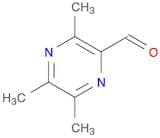
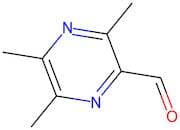
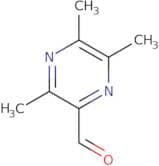
CAS 186534-02-1
:Pyrazinecarboxaldehyde, trimethyl- (9CI)
Description:
Pyrazinecarboxaldehyde, trimethyl- (9CI), with the CAS number 186534-02-1, is an organic compound characterized by its pyrazine ring structure, which is a six-membered aromatic heterocycle containing two nitrogen atoms. This compound features a carboxaldehyde functional group (-CHO) attached to the pyrazine ring, along with three methyl groups (-CH3) that contribute to its trimethyl designation. It is typically a colorless to pale yellow liquid with a distinctive odor, often described as sweet or nutty. Pyrazine derivatives are known for their applications in the food and fragrance industries due to their flavoring properties. The presence of the aldehyde group makes this compound reactive, particularly in condensation reactions and as a potential precursor in the synthesis of more complex organic molecules. Additionally, its unique structure may impart specific biological activities, making it of interest in various fields, including medicinal chemistry. Safety data should be consulted for handling and exposure guidelines, as with any chemical substance.
Formula:C8H10N2O
InChI:InChI=1/C8H10N2O/c1-5-6(2)10-8(4-11)7(3)9-5/h4H,1-3H3
SMILES:Cc1c(C)nc(C=O)c(C)n1
Synonyms:- 3,5,6-Trimethylpyrazine-2-Carbaldehyde
Sort by
Purity (%)
0
100
|
0
|
50
|
90
|
95
|
100
Found 4 products.
Pyrazinecarboxaldehyde, trimethyl- (9CI)
CAS:Formula:C8H10N2OPurity:97%Color and Shape:SolidMolecular weight:150.17783,5,6-Trimethylpyrazine-2-carbaldehyde
CAS:3,5,6-Trimethylpyrazine-2-carbaldehydePurity:99%Molecular weight:150.18g/mol3,5,6-Trimethylpyrazine-2-carbaldehyde
CAS:3,5,6-Trimethylpyrazine-2-carbaldehyde is a chemical that is used as a decoupling agent to isolate mitochondria from animal tissue. It has been shown to induce mitochondrial biogenesis in cells by activating the transcription of genes for mitochondrial proteins, including cytochrome c oxidase subunit I and II (COI and COII), NADH dehydrogenase subunit 1 (ND1), and ATP synthase beta chain (ATP5B). The compound also has damaging effects on cancer cells, causing cell cycle arrest at the G2/M phase through inhibition of DNA synthesis. 3,5,6-Trimethylpyrazine-2-carbaldehyde is synthesized by the fungus Talaromyces sp. or it can be isolated from acetate extracts of this fungus.
Formula:C8H10N2OPurity:Min. 95%Molecular weight:150.18 g/mol