CAS 186698-58-8
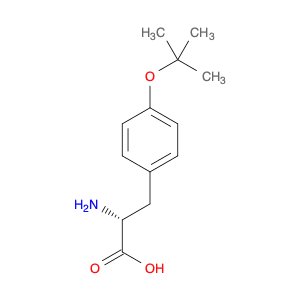
:H-D-Tyr(tBu)-OH
Description:
H-D-Tyr(tBu)-OH, also known as t-butyl L-tyrosine, is a derivative of the amino acid tyrosine, characterized by the presence of a t-butyl group attached to the phenolic hydroxyl of the tyrosine structure. This modification enhances the hydrophobicity of the molecule, making it useful in various biochemical applications, particularly in peptide synthesis and drug design. The presence of the t-butyl group can also influence the solubility and stability of the compound in different solvents. H-D-Tyr(tBu)-OH is typically utilized in the synthesis of peptides where protecting groups are necessary to prevent unwanted reactions during coupling processes. Its CAS number, 186698-58-8, allows for easy identification in chemical databases. As a building block in peptide chemistry, it plays a crucial role in the development of pharmaceuticals and research in biochemistry. The compound is generally stable under standard laboratory conditions, but like many amino acid derivatives, it should be handled with care to avoid degradation or unwanted reactions.
Formula:C13H19NO3
InChI:InChI=1/C13H19NO3/c1-13(2,3)17-10-6-4-9(5-7-10)8-11(14)12(15)16/h4-7,11H,8,14H2,1-3H3,(H,15,16)/t11-/m1/s1
SMILES:CC(C)(C)Oc1ccc(cc1)C[C@H](C(=O)O)N
Synonyms:- (2R)-2-ammonio-3-(4-tert-butoxyphenyl)propanoate
Sort by
Purity (%)
0
100
|
0
|
50
|
90
|
95
|
100
Found 4 products.
O-tert-Butyl-D-tyrosine
CAS:O-tert-Butyl-D-tyrosine is an organogelator. It is a low molecular weight organic liquid that can form a gel when mixed with a solvent. O-tert-Butyl-D-tyrosine is soluble in hydrophobic solvents such as butanol, and insoluble in water. The gelation properties of this substance are due to its ability to interact with the surface of the solvent droplet and form a network that holds other solute molecules in place. This interaction is called physisorption, which means that it does not need any chemical bonds to form the gel. Gels formed by O-tert-Butyl-D-tyrosine are stable at room temperature, but will melt when heated or exposed to pH extremes.Formula:C13H19NO3Purity:Min. 95%Molecular weight:237.29 g/mol