CAS 187795-44-4
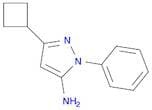
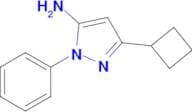
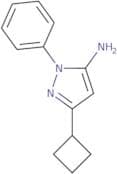
:3-Cyclobutyl-1-phenyl-1H-pyrazol-5-amine
Description:
3-Cyclobutyl-1-phenyl-1H-pyrazol-5-amine is a chemical compound characterized by its unique structure, which includes a pyrazole ring substituted with a cyclobutyl group and a phenyl group. This compound typically exhibits properties associated with both aromatic and aliphatic systems due to the presence of the phenyl and cyclobutyl moieties. It is likely to be a solid at room temperature, with potential applications in medicinal chemistry, particularly in the development of pharmaceuticals, owing to the presence of the pyrazole moiety, which is known for its biological activity. The compound may also display moderate solubility in organic solvents, while its reactivity can be influenced by the amine functional group, which can participate in various chemical reactions, including nucleophilic substitutions and coupling reactions. Additionally, the presence of the cyclobutyl group may impart unique steric and electronic properties, making it an interesting candidate for further research in drug design and synthesis.
Formula:C13H15N3
InChI:InChI=1S/C13H15N3/c14-13-9-12(10-5-4-6-10)15-16(13)11-7-2-1-3-8-11/h1-3,7-10H,4-6,14H2
InChI key:InChIKey=FFTUPFXYVRUGKW-UHFFFAOYSA-N
SMILES:NC1=CC(=NN1C2=CC=CC=C2)C3CCC3
Synonyms:- 1H-Pyrazol-5-amine, 3-cyclobutyl-1-phenyl-
- 3-Cyclobutyl-1-phenyl-1H-pyrazol-5-amine
Sort by
Purity (%)
0
100
|
0
|
50
|
90
|
95
|
100
Found 3 products.
3-cyclobutyl-1-phenyl-1H-pyrazol-5-amine
CAS:3-cyclobutyl-1-phenyl-1H-pyrazol-5-amine is an organic solvent with a boiling point of 94.2 degrees Celsius. It is used in the production of ethylene, and can be used as a desiccant or to remove hydroxyl groups from organic compounds. 3-cyclobutyl-1-phenyl-1H-pyrazol-5-amine has been shown to react with phenylphosphinic acid in the presence of dialkylamino, forming 2-(dialkylamino)ethylphosphinic acid, which then reacts with chlorine to form 2-(dialkylamino)ethyl chloride. This product also exhibits antimicrobial activity against Gram negative bacteria and trivalent cations such as mercury, silver, and gold. 3 cyclobutyl pyrazolamine can also be used to produce carbapenems by reacting with sodium chlorides in high yield.Formula:C13H15N3Purity:Min. 95%Molecular weight:213.28 g/mol