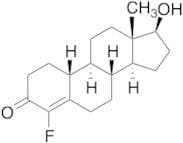
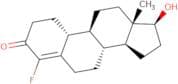
CAS 1881-31-8
:4-fluoro-19-nortestosterone
Description:
4-Fluoro-19-nortestosterone, with the CAS number 1881-31-8, is a synthetic anabolic steroid derived from testosterone. It is characterized by the presence of a fluorine atom at the 4-position and the absence of a methyl group at the 19-position, which distinguishes it from testosterone and its derivatives. This modification enhances its anabolic properties while potentially reducing androgenic effects. The compound is typically utilized in research settings and has been studied for its effects on muscle growth and performance enhancement. Its chemical structure contributes to its stability and bioactivity, making it of interest in pharmacological studies. However, like many anabolic steroids, it may also be associated with various side effects and health risks, particularly when misused. Regulatory bodies often monitor substances like 4-fluoro-19-nortestosterone due to their potential for abuse in sports and bodybuilding. As with all steroids, its use should be approached with caution and under appropriate medical guidance.
Formula:C18H25FO2
InChI:InChI=1/C18H25FO2/c1-18-9-8-11-10-4-6-15(20)17(19)13(10)3-2-12(11)14(18)5-7-16(18)21/h10-12,14,16,21H,2-9H2,1H3/t10-,11-,12-,14+,16+,18+/m1/s1
Synonyms:- 4-F-Ntt
- Estr-4-en-3-one, 4-fluoro-17-hydroxy-, (17beta)-
- (17Beta)-4-Fluoro-17-Hydroxyestr-4-En-3-One
Sort by
Purity (%)
0
100
|
0
|
50
|
90
|
95
|
100
Found 2 products.
4-Fluoro-19-nortestosterone
CAS:Controlled ProductFormula:C18H25FO2Color and Shape:NeatMolecular weight:292.3884-Fluoro-19-Nortestosterone
CAS:Controlled Product4-Fluoro-19-Nortestosterone is a stereospecific, residue-specific, and directional analog of 19-nortestosterone. It interacts with the carbonyl group by hydrogen bonding and protonation to form an amide. This interaction enhances the 4-fluoro group's ability to transfer protons from the carbonyl oxygen to the 4-hydroxyl group, which is an isomerization reaction. The presence of this hydrogen bond increases its stability. The regiospecificity of this compound has been shown in vitro by using enzymes extracted from calf thymus. The hydroxylase enzyme converts 4-fluoro testosterone into 4-fluorotestosterone, while dehydrogenase converts it into 4-fluoropregnenolone. Finally, the 17β-hydroxysteroid dehydrogenase converts it into 17β-hydroxytestosterone.Formula:C18H25FO2Purity:Min. 95%Molecular weight:292.39 g/mol