CAS 188758-77-2
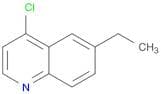
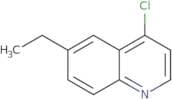
:4-chloro-6-ethylquinoline
Description:
4-Chloro-6-ethylquinoline is an organic compound belonging to the quinoline family, characterized by a bicyclic structure that includes a benzene ring fused to a pyridine ring. This compound features a chlorine atom at the 4-position and an ethyl group at the 6-position of the quinoline structure, which influences its chemical reactivity and physical properties. Typically, quinolines exhibit properties such as being weakly basic due to the nitrogen atom in the pyridine ring, and they can participate in various chemical reactions, including electrophilic substitutions and nucleophilic attacks. The presence of the chloro and ethyl substituents can affect the compound's solubility, boiling point, and reactivity, making it of interest in synthetic organic chemistry and potentially in pharmaceutical applications. Additionally, compounds like 4-chloro-6-ethylquinoline may exhibit biological activity, which warrants further investigation for potential uses in medicinal chemistry. Safety data should be consulted for handling and storage, as halogenated compounds can pose specific health and environmental risks.
Formula:C11H10ClN
InChI:InChI=1/C11H10ClN/c1-2-8-3-4-11-9(7-8)10(12)5-6-13-11/h3-7H,2H2,1H3
SMILES:CCc1ccc2c(c1)c(ccn2)Cl
Synonyms:- Quinoline, 4-Chloro-6-Ethyl-
- 4-Chloro-6-ethylquinoline
Sort by
Purity (%)
0
100
|
0
|
50
|
90
|
95
|
100
Found 2 products.
4-Chloro-6-ethylquinoline
CAS:Formula:C11H10ClNPurity:95%Color and Shape:SolidMolecular weight:191.65684-Chloro-6-ethylquinoline
CAS:<p>4-Chloro-6-ethylquinoline is a potential anticancer drug that inhibits the function of lysosomal enzymes and causes tumor cells to undergo necrosis. This drug has been shown to inhibit the growth of tumor cells in cell cultures, as well as in hypoxic tumor models. 4-Chloro-6-ethylquinoline inhibits the activity of lysosomal enzymes, which are necessary for the degradation and recycling of macromolecules and other substances within cells. It also binds to proteins on the surface of tumor cells, which prevents these proteins from functioning properly. The uptake of this drug is greater in extravascular tumor tissues than in blood vessels or normal tissue. In addition, it is taken up by tumor cells more readily than by normal cells. 4-Chloro-6-ethylquinoline binds with cytotoxins, causing them to become more cytotoxic and effective against cancerous cells. This compound has been shown to have medicinal</p>Formula:C11H10ClNPurity:Min. 95%Molecular weight:191.65 g/mol