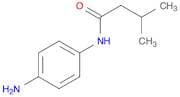
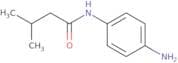
CAS 189576-50-9
:N-(4-aminophenyl)-3-methylbutanamide
Description:
N-(4-aminophenyl)-3-methylbutanamide, also known by its CAS number 189576-50-9, is an organic compound characterized by its amide functional group and an aromatic amine structure. This compound features a 4-aminophenyl group, which contributes to its potential biological activity, and a branched alkyl chain (3-methylbutanamide) that influences its solubility and reactivity. Typically, compounds of this nature may exhibit properties such as moderate to high melting points and solubility in polar solvents, depending on the specific molecular interactions. The presence of the amino group can also impart basicity, allowing for potential interactions with acids or other electrophiles. Additionally, due to its structural features, N-(4-aminophenyl)-3-methylbutanamide may be of interest in pharmaceutical research, particularly in the development of drugs targeting various biological pathways. Its safety and handling would require standard precautions typical for organic amines and amides, including proper storage and disposal methods to mitigate any potential hazards.
Formula:C11H16N2O
InChI:InChI=1/C11H16N2O/c1-8(2)7-11(14)13-10-5-3-9(12)4-6-10/h3-6,8H,7,12H2,1-2H3,(H,13,14)
SMILES:CC(C)CC(=O)Nc1ccc(cc1)N
Sort by
Purity (%)
0
100
|
0
|
50
|
90
|
95
|
100
Found 3 products.
N-(4-Aminophenyl)-3-methylbutanamide
CAS:N-(4-Aminophenyl)-3-methylbutanamide is a chloride ionophore that is used as an antimicrobial agent. It has been shown to be active against E. coli, Staphylococcus aureus, and Proteus mirabilis. The addition of N-(4-aminophenyl)-3-methylbutanamide to the growth medium leads to an increase in the number of protonated molecules on the surface of bacterial cells. This increased proton concentration increases the permeability of bacteria to chloride ions and other halides, thereby causing cell death by osmotic lysis. The activity of this compound is also enhanced by magnetic fields and fluconazole or sulphonamides.
Formula:C11H16N2OPurity:Min. 95%Molecular weight:192.26 g/mol