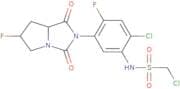
![1-chloro-N-{2-chloro-4-fluoro-5-[(6S,7aR)-6-fluoro-1,3-dioxotetrahydro-1H-pyrrolo[1,2-c]imidazol-2…](/_next/image/?url=https%3A%2Fstatic.cymitquimica.com%2Fcas-image%2Fthumb-webp%2F500836-1-chloro-n-2-chloro-4-fluoro-5-6s-7ar-6-fluoro-13-dioxotetrahydro-1h-pyrrolo-12-c-imidazol-2-3h-yl-phenyl-methanesulfonamide.webp&w=3840&q=75)
CAS 190314-43-3
:1-chloro-N-{2-chloro-4-fluoro-5-[(6S,7aR)-6-fluoro-1,3-dioxotetrahydro-1H-pyrrolo[1,2-c]imidazol-2(3H)-yl]phenyl}methanesulfonamide
Description:
1-Chloro-N-{2-chloro-4-fluoro-5-[(6S,7aR)-6-fluoro-1,3-dioxotetrahydro-1H-pyrrolo[1,2-c]imidazol-2(3H)-yl]phenyl}methanesulfonamide, with CAS number 190314-43-3, is a synthetic organic compound characterized by its complex molecular structure, which includes multiple functional groups such as a sulfonamide, chloro, and fluoro substituents. This compound is notable for its potential biological activity, particularly in medicinal chemistry, where it may serve as a lead compound for the development of pharmaceuticals. The presence of the dioxotetrahydropyrroloimidazole moiety suggests possible interactions with biological targets, potentially influencing enzyme activity or receptor binding. Its solubility and stability in various solvents can vary, impacting its application in drug formulation. Additionally, the stereochemistry indicated by the (6S,7aR) configuration may play a crucial role in its biological efficacy and pharmacokinetics. Overall, this compound exemplifies the complexity often found in drug-like molecules, combining various chemical functionalities that can affect its therapeutic potential.
Formula:C13H11Cl2F2N3O4S
InChI:InChI=1/C13H11Cl2F2N3O4S/c14-5-25(23,24)18-9-3-10(8(17)2-7(9)15)20-12(21)11-1-6(16)4-19(11)13(20)22/h2-3,6,11,18H,1,4-5H2/t6-,11+/m0/s1
Sort by
Purity (%)
0
100
|
0
|
50
|
90
|
95
|
100
Found 1 products.
Profluazol
CAS:Profluazol is an inhibitor of protein kinases that has shown potential in the treatment of cancer. This Chinese indole derivative has been found to inhibit the proliferation of leukemia cells and induce apoptosis in tumor cell lines. Profluazol specifically targets kinases involved in the regulation of cell cycle progression, such as cyclin-dependent kinase 2 (CDK2) and mitogen-activated protein kinase (MAPK), leading to a decrease in cancer cell growth. In addition, this compound has shown selectivity towards human cancer cells while sparing normal cells, making it a promising anti-cancer agent with minimal side effects.
Formula:C13H11Cl2F2N3O4SPurity:Min. 95%Molecular weight:414.2 g/mol